

- Types of Fake Plants by Material
- How to Choose Between Different Types of Fake Plants
- What Types of Fake Plants Look the Most Realistic?
- 2026 Fake Plant Design Trends
- New Technology Changing Artificial Plants
- Advantages of Having Multiple Types of Fake Plants Available
- Common Mistakes When Buying Different Types of Fake Plants
- How to Maintain Different Types of Fake Plants
- Final Buying Checklist
- Laatste gedachten
- FAQ
Fake plants are no longer limited to shiny plastic leaves in small office pots. Today, there are many types of fake plants designed for very different purposes—from realistic artificial trees for living rooms and hotels to UV-resistant hedges for outdoor terraces, miniature faux succulents for desks, hanging greenery for restaurants, and modular green walls for large commercial projects.
That variety creates a new problem for buyers: which type should you actually choose?
A product that works beautifully on a bookshelf may fail outdoors. A realistic artificial olive tree may be ideal for a residential interior but unsuitable for a public commercial installation without the required fire-performance documentation. Likewise, artificial flowers, succulents, trees, green walls, and outdoor foliage differ significantly in construction, materials, maintenance, appearance, and price.
This complete guide explains the major types of fake plants, how they are made, where each works best, what quality features to compare, and how new materials and technology are changing artificial greenery in 2026.
Whether you are decorating a home, sourcing products for a retail business, planning a hotel or restaurant project, or purchasing artificial greenery in bulk, understanding the different categories will help you make a more practical long-term decision.
What Are the Main Types of Fake Plants?
The easiest way to understand artificial greenery is to classify it by form and application.
The major types of fake plants include:
- Artificial potted plants
- Artificial trees
- Artificial succulents and cacti
- Artificial hanging plants and vines
- Artificial flowers and floral arrangements
- Artificial grasses
- Artificial topiary plants
- Artificial hedges and privacy screens
- Artificial green walls
- Outdoor UV-resistant artificial plants
- Commercial artificial greenery
- Custom artificial plant installations
Each category serves a different design purpose, and many are available in both residential and commercial grades.
1. Artificial Potted Plants
Artificial potted plants are probably the most familiar category and one of the most versatile types of fake plants.
They range from small tabletop plants only a few inches high to large floor-standing specimens. Common designs imitate Monstera, pothos, ferns, snake plants, calatheas, philodendrons, eucalyptus, palms, and other popular indoor foliage.
Where They Work Best
Artificial potted plants are suitable for:
- Living rooms
- Bedrooms
- Kitchens
- Bathrooms
- Offices
- Hotels
- Reception areas
- Retail displays
- Restaurants
- Rental properties
Their biggest advantage is flexibility. A small plant can be placed on a shelf, while a larger specimen can soften an empty corner or visually divide a room.
What to Look For
A convincing artificial potted plant should have variation in leaf angle, size, texture, and color. Leaves that are perfectly symmetrical or excessively glossy often look less realistic.
Recent interior-design advice also emphasizes shaping artificial foliage rather than leaving stems in their factory position. Bending stems, varying their height, introducing slight irregularity, and hiding visible foam or plastic at the base can make faux greenery look substantially more believable.
For a deeper purchasing checklist, see the Fake Plants Buying Guide.
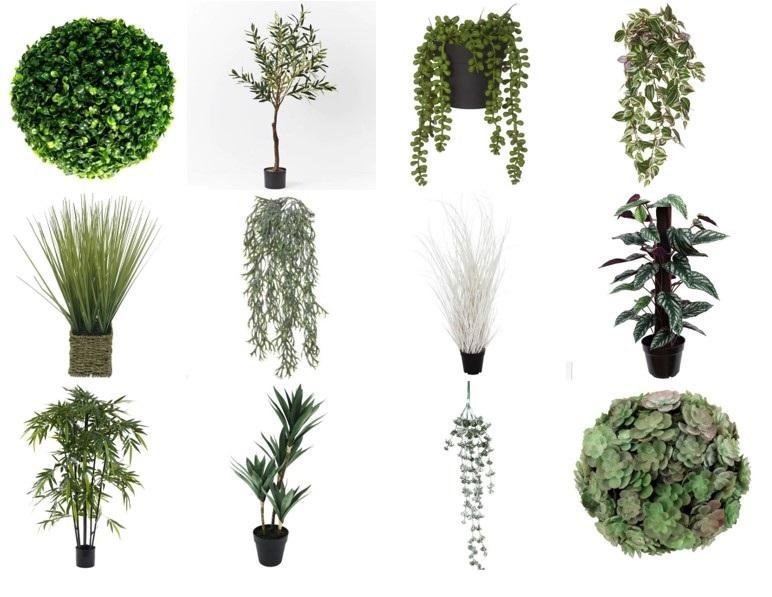
types of fake plants for modern homes and commercial spaces2. Artificial Trees
Artificial trees are among the most visually powerful types of fake plants because they add height, structure, and architectural impact.
Popular artificial tree styles include:
- Olive trees
- Ficus trees
- Fiddle-leaf figs
- Rubber trees
- Palms
- Banana plants
- Bird-of-paradise plants
- Eucalyptus trees
- Citrus trees
- Bamboo
- Artificial bonsai trees
Artificial trees may use entirely molded trunks or combine synthetic foliage with natural wood trunks and branches.
Why Artificial Trees Often Look More Convincing
Large faux trees can sometimes appear more realistic than small artificial plants because viewers generally see them from a greater distance. Their overall silhouette becomes more important than the details of one individual leaf.
Designers interviewed by House Beautiful have similarly noted that larger artificial trees can create a convincing sculptural effect when the scale, planter, and placement are appropriate.
Best Uses
Artificial trees are especially useful in:
- Large living rooms
- Hotel lobbies
- Shopping malls
- Restaurants
- Office reception areas
- Showrooms
- Event spaces
- Staged properties
One well-proportioned tree can often create more impact than several small decorative plants.
Common Buying Mistake
A large tree supplied in a tiny black nursery-style pot rarely looks finished.
Place it inside a larger decorative planter and cover the visible base with moss, gravel, bark, decorative stone, or another appropriate material.
3. Artificial Succulents and Cacti
Artificial succulents are one of the smallest but most versatile categories.
Because real succulents already have thick, waxy, geometrical leaves, high-quality artificial versions can reproduce their forms particularly effectively.
Common styles include:
- Echeveria
- Aloe
- Haworthia
- Agave
- Sedum
- String-of-pearls
- Jade plants
- Barrel cactus
- Columnar cactus
- Opuntia-style prickly pear
Artificial succulent arrangements may combine several species in one planter, creating miniature desert landscapes.
Where Artificial Succulents Work Best
They are ideal for:
- Office desks
- Bookshelves
- Bathrooms
- Coffee tables
- Reception counters
- Hotel rooms
- Wedding tables
- Event centerpieces
- Gift arrangements
- Retail displays
Because of their compact size, they are also easy to ship, store, and rearrange.
Design Trend
Instead of placing one tiny succulent randomly on a desk, designers increasingly use clustered arrangements with varying heights, textures, and container materials.
A group of three different faux succulents in stone, ceramic, or concrete-style planters usually looks more intentional than several identical plastic pots.
Read more in our guide to Artificial Succulents.
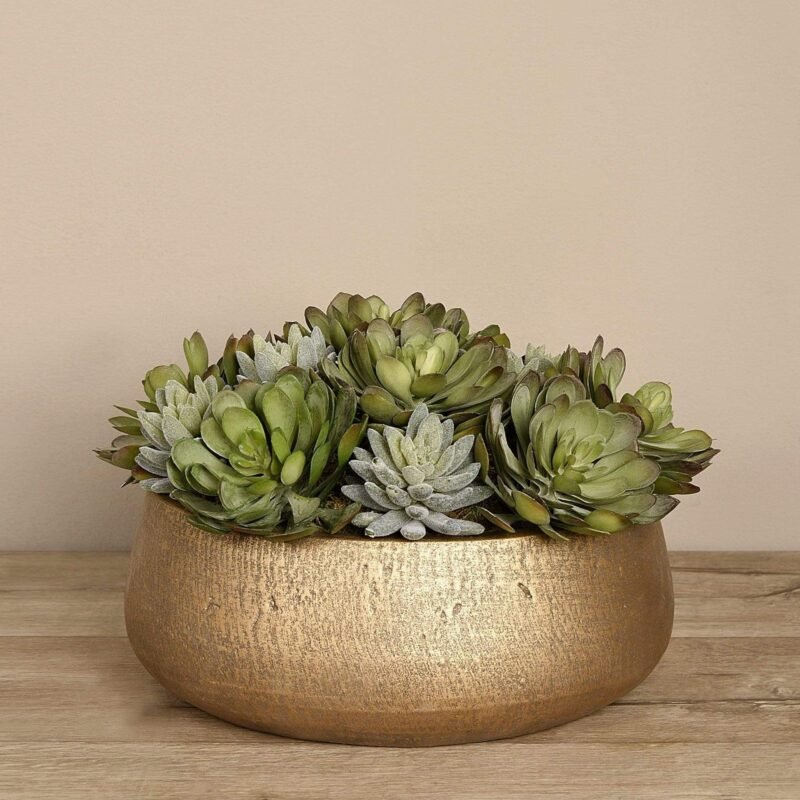
types of fake plants including artificial succulents and cacti4. Artificial Hanging Plants and Vines
Hanging greenery adds movement to spaces where floor and table space is limited.
Popular designs include artificial versions of:
- Pothos
- Ivy
- Philodendron
- String-of-pearls
- Tradescantia
- Ferns
- Eucalyptus
- Wisteria
- Grapevines
- Tropical trailing foliage
These types of fake plants are particularly useful on tall shelves, hanging baskets, ceiling installations, restaurant walls, and retail displays.
Residential Uses
At home, artificial hanging plants can soften:
- Bookshelves
- Kitchen shelving
- Bathroom storage
- High cabinets
- Balcony walls
- Window frames
However, excessive artificial vines can quickly make a room feel cluttered.
Using one or two well-positioned trailing plants usually creates a cleaner result than covering every shelf with greenery.
Commercial Uses
Restaurants and event designers commonly use artificial trailing plants above dining areas, bars, pergolas, and ceilings.
In commercial environments, installation safety becomes especially important. Plants must be securely fixed and must not interfere with lighting, sprinklers, exit routes, or required building systems.
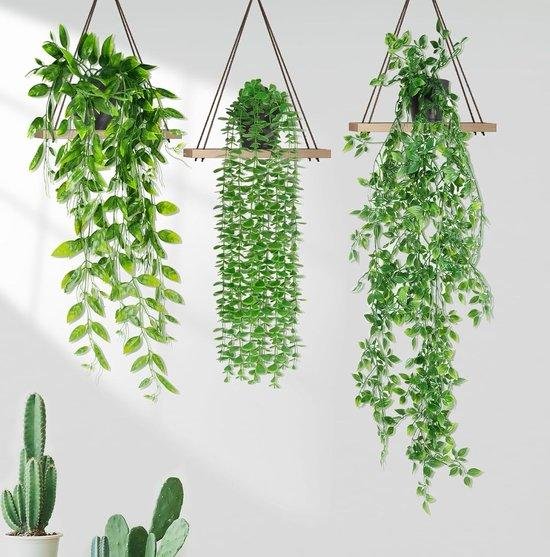
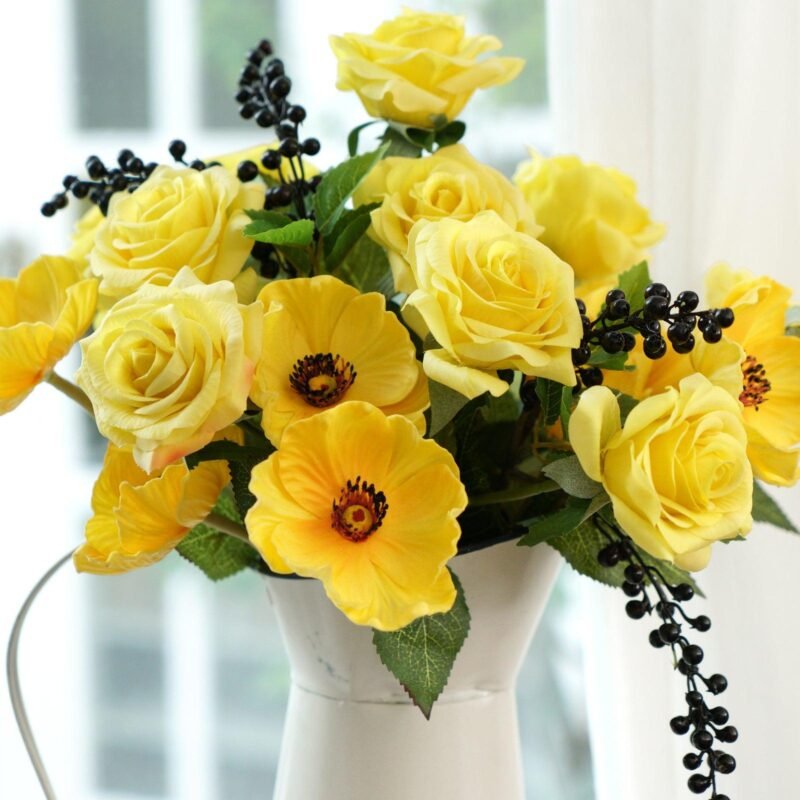
artificial hanging plants and faux trailing vines5. Artificial Flowers
Artificial flowers are technically a separate category from foliage plants, but buyers commonly include them when discussing the different types of fake plants.
Popular artificial flowers include:
- Roses
- Hydrangeas
- Peonies
- Orchids
- Tulips
- Lilies
- Sunflowers
- Dahlias
- Cherry blossoms
- Wisteria
- Wildflower-style stems
Artificial flowers can be sold as individual stems, bouquets, centerpieces, wreaths, wedding installations, potted orchids, or large decorative arrangements.
“Silk Flowers” Do Not Always Mean Silk
The term silk flower is widely used as a general description for premium artificial flowers. Many modern products, however, use polyester or other synthetic textile materials rather than natural silk.
Therefore, commercial buyers should examine material specifications rather than relying only on the marketing name.
Real-Touch Flowers
Real-touch artificial flowers are designed to reproduce not only the appearance but also some of the softness and flexibility of natural petals.
Higher-end products may use detailed molding, layered coloring, and flexible coatings to create a more natural tactile experience.
Artificial florals remain particularly useful for weddings, hospitality, seasonal displays, and environments requiring a consistent appearance.
See our Artificial Flowers Guide for more detail.
6. Artificial Grasses
Artificial grasses are often overlooked, but they are useful where a designer wants movement and texture without the visual weight of a large leafy plant.
Common products imitate:
- Pampas-style grasses
- Reed grass
- Fountain grass
- Wheat-like grasses
- Bamboo grass
- Ornamental meadow grasses
Artificial grass arrangements are commonly installed in long rectangular planters.
Ideal Applications
They work particularly well in:
- Office dividers
- Restaurant partitions
- Hotel corridors
- Retail stores
- Reception areas
- Modern residential interiors
Tall grasses can create visual separation while maintaining an open feeling.
They are also easier to repeat consistently across a large commercial project than naturally growing grasses that change throughout the year.
7. Artificial Topiary Plants
Topiary is one of the more structured types of fake plants.
These products imitate plants trimmed into deliberate geometric forms such as:
- Balls
- Spirals
- Cones
- Pyramids
- Columns
- Double-ball topiary
- Animal shapes
- Sculptural forms
Boxwood is one of the most common plants imitated in artificial topiary.
Where Topiary Works
Artificial topiary is popular around:
- Hotel entrances
- Restaurants
- Retail storefronts
- Wedding venues
- Patios
- Doorways
- Formal gardens
- Commercial reception areas
Because topiary is intentionally geometric, artificial construction can look convincing if the foliage density and color variation are realistic.
Outdoor installations should use products specifically rated for exterior conditions rather than standard indoor foliage.
8. Artificial Hedges and Privacy Screens
Artificial hedges combine decorative greenery with a functional purpose.
They can create:
- Privacy
- Visual separation
- Background screening
- Temporary partitions
- Decorative boundaries
Common styles include artificial boxwood, ivy, laurel, bamboo, and mixed foliage.
Residential Applications
Artificial hedge panels are frequently used on:
- Balconies
- Fences
- Small patios
- Rooftop terraces
- Apartment privacy screens
Commercial Applications
They are commonly used around:
- Restaurant seating
- Hotel terraces
- Pools
- Event venues
- Outdoor retail areas
- Office breakout spaces
Wind loading and attachment should be considered carefully. A lightweight artificial hedge can behave like a sail in exposed locations.
For exterior projects, UV performance is also important.
9. Artificial Green Walls
Artificial green walls have become one of the most visible commercial types of fake plants.
Rather than using individual pots, foliage is attached to modular backing panels that can cover part or all of a wall.
Common designs include:
- Boxwood walls
- Fern walls
- Tropical mixed foliage
- Moss-effect walls
- Floral walls
- Jungle-style walls
- Branded feature walls
Why Modular Panels Are Popular
Modular systems make it easier to:
- Cover large surfaces
- Create repeatable patterns
- Replace damaged sections
- Transport projects
- Adapt installations to different wall sizes
- Integrate logos and signage
They are frequently used as photographic backgrounds, reception features, restaurant installations, event walls, and office branding areas.
Green Walls and Fire Regulations
Commercial buyers should pay close attention to fire-performance requirements.
The 2024 International Fire Code states that artificial decorative vegetation may need to meet specified flame-propagation performance criteria, including testing under NFPA 701 or an accepted alternative depending on the application. The 2025 California Fire Code similarly includes specific provisions for artificial decorative vegetation. Requirements depend on jurisdiction, occupancy, installation, and other building conditions.
For commercial projects, never assume that a product described simply as “fire resistant” satisfies local requirements. Request documentation for the exact supplied product and confirm acceptance with the relevant architect, fire consultant, contractor, or authority.
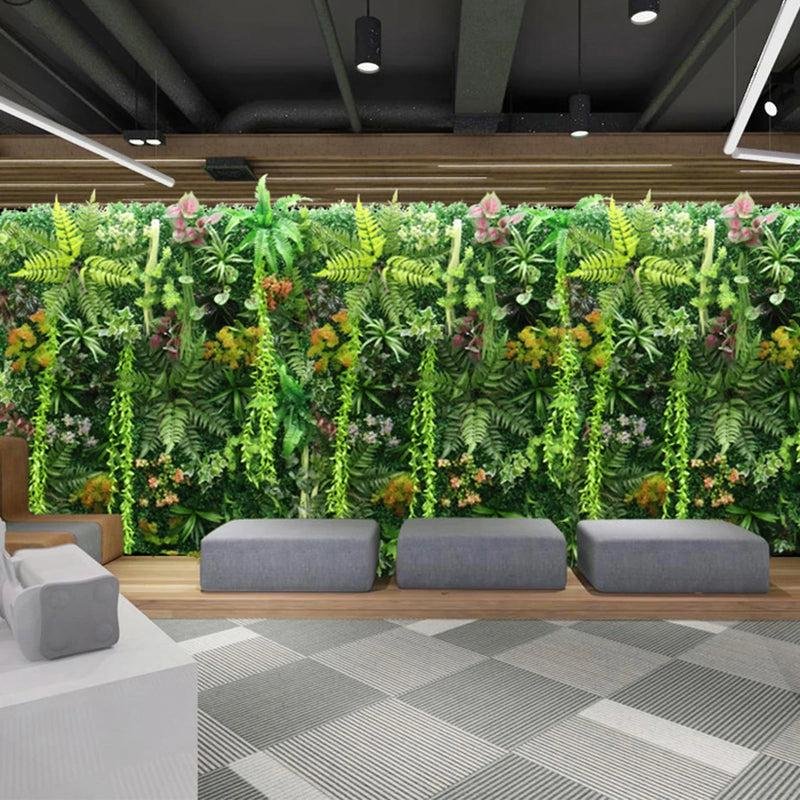
types of fake plants used in a commercial artificial green wall10. Outdoor UV-Resistant Artificial Plants
One of the most important distinctions is between indoor and outdoor artificial greenery.
Standard indoor artificial plants may fade, weaken, discolor, or become brittle when continuously exposed to sunlight and weather.
Outdoor products may incorporate materials, coatings, pigments, or stabilizers intended to improve resistance to UV exposure.
Common exterior types of fake plants include:
- Artificial palms
- Boxwood balls
- Hedges
- Topiary
- Bamboo
- Outdoor grasses
- Ivy screens
- Flowering plants
- Artificial trees
Questions to Ask Before Buying
Do not rely only on the phrase “outdoor suitable.”
Ask about:
- UV testing
- Expected exposure conditions
- Warranty terms
- Temperature limitations
- Colorfastness
- Wind resistance
- Drainage
- Installation method
No artificial outdoor plant remains unchanged forever. Exposure level, climate, material, orientation, and maintenance can all influence service life.
Read our detailed guide to Outdoor Artificial Plants.
outdoor types of fake plants with UV resistant greenery11. Artificial Potted Arrangements
Not every artificial plant needs to imitate a single species.
Mixed arrangements combine different foliage types in one decorative container.
Examples include:
- Succulent bowls
- Tropical foliage arrangements
- Fern combinations
- Flower-and-greenery arrangements
- Grass planters
- Mixed commercial planter boxes
These products work particularly well when buyers need a finished decorative item rather than individual stems.
For hospitality and commercial projects, preassembled planters can also help standardize appearance across multiple locations.
Learn more about Artificial Potted Plants.
12. Custom Artificial Plant Installations
At the highest end of the market, artificial greenery becomes part of architectural design rather than a standalone decorative product.
Custom projects can include:
- Artificial trees built around columns
- Ceiling greenery
- Large restaurant canopies
- Branded plant walls
- Artificial garden displays
- Event installations
- Shopping-mall landscapes
- Exhibition displays
- Customized hotel planters
These projects may combine several types of fake plants to achieve a more natural result.
For example, a hotel installation might use artificial palms for height, ferns at mid-level, trailing foliage at the edges, and small ground-cover plants around the base.
The goal is similar to natural landscape design: create layers rather than repeat one identical plant everywhere.
Types of Fake Plants by Material
Form is only one way to classify artificial greenery. Material also affects appearance, durability, flexibility, cost, and suitable application.
Plastic Artificial Plants
Plastic is widely used because it can be molded into complex leaf forms and produced consistently at scale.
Depending on product construction, materials may include different polymers and blends.
Plastic foliage is particularly common for:
- Outdoor greenery
- Succulenten
- Boxwood
- Ferns
- Hedges
- Green walls
- Small foliage plants
Advantages can include durability, water resistance, detailed molding, and easy cleaning.
The disadvantages are that low-quality products may be overly shiny, rigid, or visually repetitive.
Polyester and Fabric Artificial Plants
Textile materials are commonly used for flowers and delicate leaves.
They can produce thin edges and soft shapes that are harder to achieve with thicker molded plastic.
Fabric products may be particularly effective for:
- Flowers
- Large tropical leaves
- Decorative stems
- Floral arrangements
They can, however, attract dust and may not be suitable for wet outdoor environments unless specifically engineered for them.
Real-Touch Materials
“Real-touch” describes products designed to feel more lifelike when touched.
The exact formulation varies between manufacturers.
These products are popular for:
- Orchids
- Roses
- Tulips
- Succulent leaves
- Premium foliage
Real-touch construction can improve realism, but buyers should still evaluate durability, cleaning requirements, temperature resistance, and intended use.
Artificial Plants With Natural Wood Trunks
Some premium artificial trees combine manufactured foliage with preserved or dried natural wood trunks.
This can improve visual realism because no two trunks are identical.
However, natural materials can introduce variations in color, size, shape, and long-term behavior.
They may also affect whether a product is appropriate for exterior or heavily regulated commercial installations.
How to Choose Between Different Types of Fake Plants
Instead of asking “Which fake plant is best?” ask “Which fake plant is best for this particular location?”
| Location | Recommended Type | Main Priority |
|---|---|---|
| Living room | Artificial tree or large potted plant | Realism and scale |
| Bedroom | Small potted foliage | Soft appearance |
| Bathroom | Fern or trailing plant | Humidity-resistant materials |
| Office desk | Succulent or small potted plant | Compact size |
| Hotel lobby | Large tree or custom planter | Visual impact |
| Restaurant | Hanging greenery or green wall | Installation and maintenance |
| Balcony | UV-resistant plant or hedge | Outdoor durability |
| Retail store | Modular greenery | Flexibility |
| Event venue | Flowers and foliage installations | Fast installation |
| Commercial wall | Artificial green wall | Fire and project specifications |
What Types of Fake Plants Look the Most Realistic?
Realism depends more on quality and styling than on plant category alone.
However, some plant forms naturally translate well into artificial materials.
Succulents are effective because natural succulent leaves already look waxy and geometric. Olive trees can look convincing because their small leaves are viewed from a distance. Snake plants have relatively simple leaf structures. Trailing vines benefit from being positioned above eye level.
Artificial flowers are often harder to perfect because people naturally inspect petals closely.
A 2026 styling feature from House Beautiful recommends deliberately avoiding excessive uniformity: trimming or varying stem heights, bending foliage, introducing slight drooping, and disguising artificial bases can all help reduce the manufactured appearance.
2026 Fake Plant Design Trends
The artificial greenery market is moving away from the idea that every fake plant must look perfectly symmetrical and permanently new.
Several broader directions are becoming increasingly visible.
More Natural Imperfection
Premium artificial plants increasingly emphasize irregular leaf angles, less uniform silhouettes, subtle color changes, and realistic branching.
Natural plants are imperfect, so artificial plants often become more convincing when manufacturers stop trying to make every leaf identical.
Larger Statement Plants
Large artificial olive trees, ficus trees, palms, and architectural foliage continue to work well because they provide height and visual structure.
Recent design coverage has continued to feature faux olive trees and other large artificial specimens as practical solutions where real trees would be difficult to maintain.
Mixed Natural and Artificial Greenery
The future may not be “fake versus real.”
Many spaces can benefit from combining them.
Live plants can occupy windows and easy-to-maintain areas, while artificial plants fill dark corners, high shelves, inaccessible installations, or locations that require consistent appearance.
Better Containers
Consumers increasingly judge the entire presentation rather than the foliage alone.
Natural stone, textured ceramics, woven baskets, terracotta, wood, and architectural fiberglass planters can dramatically improve how artificial plants are perceived.
Less Is More
Artificial greenery is most convincing when used deliberately.
Recent interior-design commentary shows that fake plants remain somewhat divisive: some designers value high-quality faux greenery in difficult environments, while others argue that poor-quality or overused artificial plants can make spaces look dated.
That debate reinforces an important buying principle: quality, context, and restraint matter more than simply adding more plants.
New Technology Changing Artificial Plants
Different types of fake plants are also benefiting from advances in manufacturing and design technology.
Higher-Resolution Molding
Modern tooling can reproduce finer leaf details, including veins, edges, wrinkles, and surface texture.
The result can reduce the flat appearance of older plastic foliage.
Multi-Layer Coloring
Instead of applying one green color to an entire leaf, better products may combine several tones.
Manufacturers can introduce darker veins, pale undersides, brown leaf edges, or lighter new-growth areas.
Improved Flexible Construction
Wire-reinforced stems and flexible materials allow designers and consumers to change leaf positions after shipping.
This matters because artificial plants are frequently compressed inside cartons.
A plant that can be reshaped has a better chance of developing a natural silhouette after unpacking.
UV-Resistant Materials
Outdoor products continue to evolve through improved stabilization systems and manufacturing processes intended to slow degradation from sunlight.
However, buyers should distinguish between marketing claims and documented testing.
AI and Digital Visualization
Artificial greenery suppliers, interior designers, and project planners can increasingly use AI visualization, 3D rendering, and augmented-reality tools to preview how different trees, green walls, planters, and decorative arrangements may look before installation.
For large projects, visualization can help evaluate:
- Scale
- Density
- Color
- Planter dimensions
- Sightlines
- Wall coverage
- Plant combinations
This can reduce expensive mistakes before physical products arrive.
Advantages of Having Multiple Types of Fake Plants Available
The wide range of artificial plant categories allows designers to solve very different problems.
Artificial trees provide vertical scale. Succulents fill small spaces. Hanging foliage works overhead. Hedges create privacy. Green walls turn unused vertical surfaces into decorative features. Flowers provide color, while grasses introduce movement and texture.
Other practical advantages may include:
- No watering
- No pruning
- No soil
- No seasonal dormancy
- Predictable appearance
- Easier placement in dark areas
- Reduced routine plant-care requirements
At the same time, artificial greenery does not provide the biological functions of living plants and still requires cleaning and eventual replacement.
For a balanced overview, see our guides to the Advantages of Fake Plants en Disadvantages of Fake Plants.
Common Mistakes When Buying Different Types of Fake Plants
Choosing by Photo Alone
A product may look convincing in a styled photograph but very different under normal lighting.
Whenever possible, evaluate close-up images, dimensions, materials, branching, leaf density, and customer or project samples.
Ignoring Scale
Always measure the intended location before ordering.
A tree that looks large in a photograph may appear surprisingly small beside a high ceiling.
Using Indoor Products Outdoors
This can lead to premature fading and material degradation.
Choose exterior-grade products when weather exposure is expected.
Ignoring the Planter
The wrong pot can make an expensive artificial plant look cheap.
Consider the planter part of the total design.
Choosing Too Many Varieties
A room containing every possible type of artificial plant may look more like a showroom than a designed environment.
Repeat a limited number of species or visual forms.
Ignoring Commercial Requirements
For hotels, offices, restaurants, malls, and public spaces, appearance is only one part of product selection.
Fire performance, installation, accessibility, cleaning, durability, and applicable codes may also matter.
How to Maintain Different Types of Fake Plants
Fake plants are low maintenance, not zero maintenance.
Artificial trees and large foliage should be dusted regularly. Small succulents can be cleaned with a soft brush. Green walls may require vacuuming or air cleaning depending on the installation. Outdoor products should be checked for fading, loose fittings, wind damage, and accumulated dirt.
Do not automatically wash every artificial plant with water. Products containing natural trunks, adhesives, paper components, fabrics, specialty coatings, or internal metal parts may require different methods.
Regular cleaning is especially important because dust reduces color contrast and is one of the fastest ways to make artificial plants look obviously fake.
Final Buying Checklist
Before choosing among the different types of fake plants, ask:
- Where will the plant be installed?
- Is it for indoor or outdoor use?
- How close will people stand to it?
- What size fits the space?
- Does it need to provide height, color, privacy, or texture?
- Is realistic appearance the main priority?
- Is UV resistance required?
- Are fire-performance documents required?
- How will it be cleaned?
- Can leaves and stems be reshaped?
- Does the planter need upgrading?
- Can damaged parts be replaced?
- Will it still fit the space aesthetically in several years?
- Is the product suitable for residential or commercial use?
The best purchase is not necessarily the most expensive product. It is the product whose material, scale, quality, durability, and application match the project.
Laatste gedachten
Understanding the different types of fake plants makes artificial greenery much easier to buy and design with.
For small residential spaces, artificial succulents, potted foliage, and hanging plants offer simple decorative flexibility. Large homes and hospitality interiors can benefit from artificial trees and statement planters. Restaurants and offices may use hanging greenery, modular planters, and green walls. Outdoor projects require products designed for weather and UV exposure, while commercial installations may also need documented fire-performance characteristics.
The market is also moving toward better realism. More detailed molds, multi-tone coloring, flexible stems, improved outdoor materials, and digital visualization are giving designers more options than earlier generations of artificial plants offered.
But technology alone does not guarantee a convincing result.
The most successful artificial greenery still depends on choosing the right plant for the right location, using realistic proportions, avoiding excessive repetition, selecting good containers, shaping the foliage properly, and maintaining it over time.
Instead of asking whether fake plants are universally better or worse than live plants, a more useful question is:
Which type of greenery solves the design and maintenance needs of this particular space?
Once that question is clear, choosing among the many types of fake plants becomes much simpler.
FAQ
What are the most common types of fake plants?
The most common types include artificial potted plants, trees, succulents, cacti, hanging plants, flowers, grasses, topiary, hedges, green walls, and outdoor UV-resistant greenery.
Which type of fake plant looks most realistic?
High-quality artificial trees, succulents, snake plants, olive trees, and some trailing plants can look especially convincing. Realism depends heavily on leaf texture, color variation, shape, placement, and styling.
What are fake plants usually made from?
Artificial plants may use molded plastics, synthetic textiles such as polyester, flexible real-touch materials, metal wire, foam, natural wood trunks, and combinations of these materials.
Are silk plants actually made of silk?
Not necessarily. “Silk plant” has become a general industry term for artificial foliage and flowers. Many products marketed as silk plants use polyester or other synthetic materials.
What types of fake plants are best for outdoor use?
Choose artificial plants specifically designed for exterior exposure, such as UV-resistant hedges, topiary, palms, grasses, boxwood, and outdoor artificial trees.
Can artificial plants be used in restaurants and hotels?
Yes, but commercial projects should consider cleaning, durability, installation, accessibility, local fire regulations, and any required testing documentation in addition to appearance.
Are artificial green walls better than individual fake plants?
Neither is universally better. Green walls are useful when covering large vertical surfaces, while individual plants provide greater flexibility and are easier to move or replace.
How long do fake plants last?
Lifespan varies significantly according to material quality, sunlight exposure, indoor or outdoor conditions, cleaning, handling, and construction. Outdoor exposure generally places more stress on materials than protected indoor use.
 English
  Arabic
  Dutch
Dutch  German
  French
  Portuguese
  Spanish
  Russian
  Japanese
  Korean