

- What Are Fabric Flowers?
- How Fabric Flowers Are Made
- Common Materials Used for Fabric Flowers
- Fabric Flowers vs. Plastic and Real-Touch Flowers
- Why People Choose Fabric Flowers
- How to Judge the Quality of Fabric Flowers
- Best Uses for Fabric Flowers
- How to Style Fabric Flowers So They Look Real
- A Practical Fabric Flowers Buying Checklist
- Wholesale and Commercial Purchasing Considerations
- Cost and Long-Term Value
- Cleaning and Caring for Fabric Flowers
- Indoor, Outdoor, and Fire-Safety Considerations
- Sustainability and Environmental Claims
- Common Mistakes When Buying Fabric Flowers
- Frequently Asked Questions About Fabric Flowers
- Final Buying Advice
- External Sources
Fresh flowers can transform a room, wedding, shop window, or dining table. The problem is that their beauty is temporary. They wilt, shed petals, require water, and may need to be replaced within days.
Plastic flowers solve the maintenance problem, but lower-quality products can look shiny, rigid, or obviously manufactured. This leaves many buyers searching for something softer and more realistic.
That is where fabric flowers offer a practical alternative.
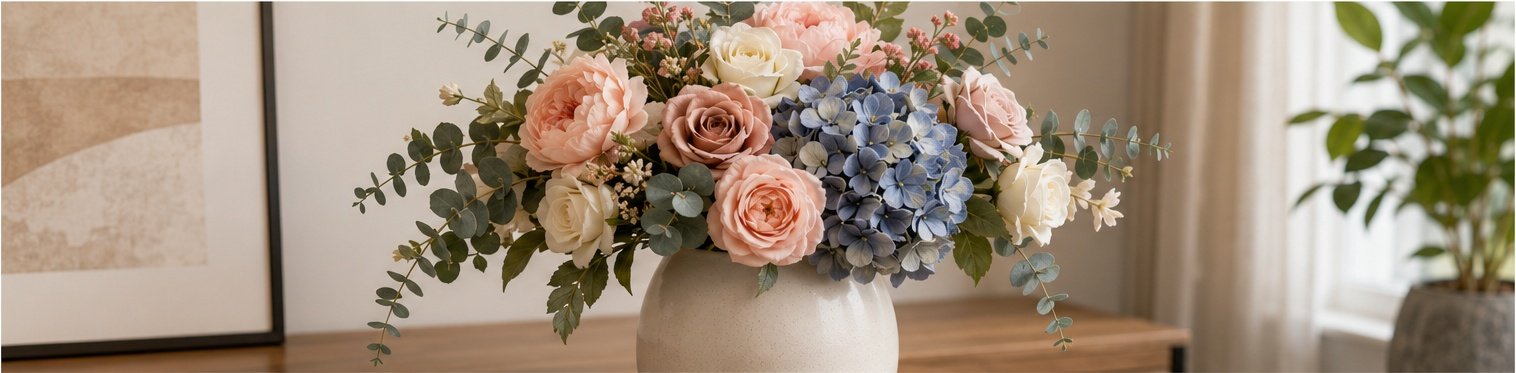
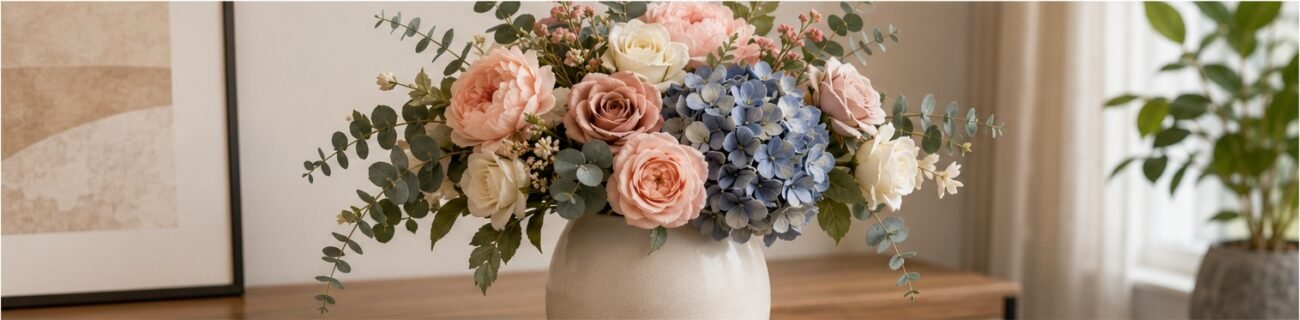
Well-made fabric flowers can reproduce the layered petals, soft edges, color transitions, and natural movement of roses, peonies, hydrangeas, dahlias, orchids, and many other species. They can be reused for seasonal decorating, wedding arrangements, retail displays, gifts, photography, and everyday interior styling.
However, not all fabric flowers are equal. Material composition, petal cutting, printing, shaping, stem construction, color accuracy, and final assembly all affect quality.
This guide explains what fabric flowers are, how they are made, which materials perform best, how to judge realism, where to use them, and what to check before placing a retail or wholesale order.
What Are Fabric Flowers?
Fabric flowers are artificial flowers made with woven or nonwoven textile materials, usually supported by plastic, wire, foam, or molded components.
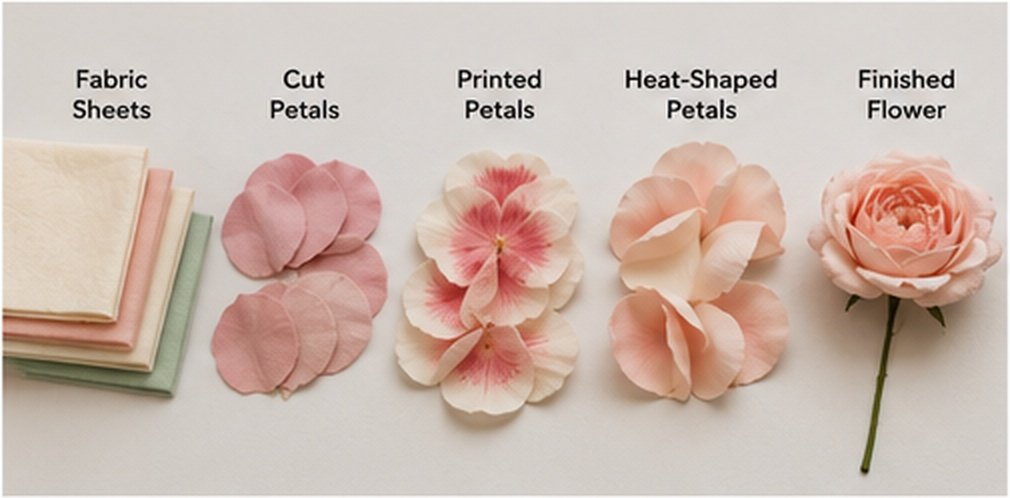
The petals may be made from polyester, synthetic silk, cotton blends, velvet, satin, organza, or other specialty fabrics. Manufacturers cut the fabric into petal shapes, apply color, add texture, and shape each section with heat or molds.
The term “silk flowers” is widely used in retail, but it does not always mean the petals are made from natural silk. Many modern silk-style flowers use polyester or synthetic fabric because these materials are more consistent, affordable, colorfast, and suitable for large-scale production.
A complete fabric flower may include:
- Fabric petals
- Molded plastic or foam centers
- Wire-supported stems
- Plastic or fabric leaves
- Printed veins and color gradients
- Wrapped or coated stem surfaces
- Adhesive or heat-bonded connections
Premium artificial flowers often combine several materials because petals, centers, leaves, and stems have different structural requirements. A flower with soft fabric petals may use a molded center, flexible plastic leaves, internal wire, and a textured stem coating.
How Fabric Flowers Are Made
The manufacturing process varies by flower style, price level, and production volume. However, most products follow several basic steps.
1. Fabric Selection
The manufacturer begins by selecting a fabric with the appropriate weight, weave, surface texture, stiffness, and light reflection.
Thin fabrics work well for delicate petals, while heavier fabrics provide structure for large roses, magnolias, sunflowers, and dahlias. Matte surfaces generally look more natural than highly reflective fabrics.
Polyester is common because it can be cut consistently, dyed in many colors, heat-shaped, and produced at scale. Silk blends or specialty fabrics may be used when a softer hand feel or more luxurious appearance is required.
2. Petal Cutting
Petals are cut using dies, automated cutting machines, lasers, or hand tools.
A low-cost flower may use only one or two petal shapes. A more realistic flower often uses several sizes and shapes to reproduce the way natural petals develop from the center outward.
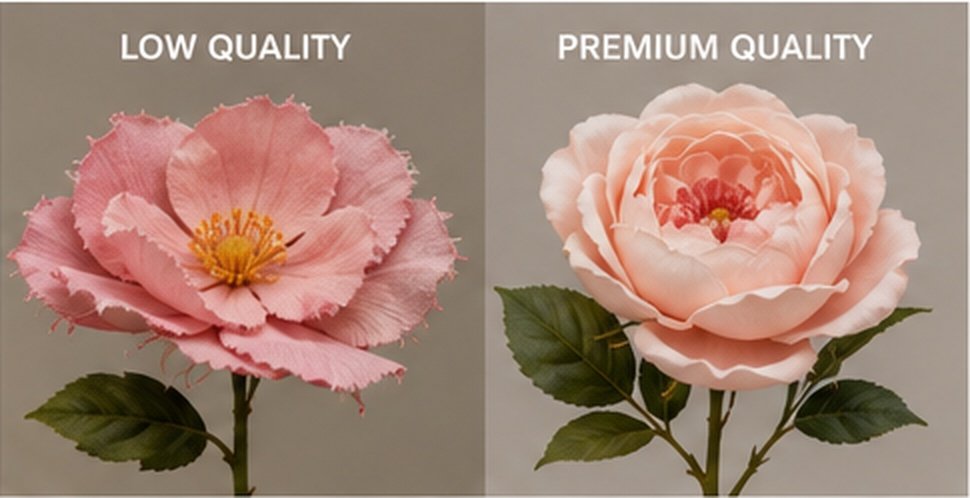
Clean edges are important. Frayed, uneven, or heavily melted edges can make fabric flowers look inexpensive when viewed closely.
3. Coloring and Printing
Color may be applied before or after the petals are cut.
Common methods include:
- Solid fabric dyeing
- Screen printing
- Digital printing
- Airbrushing
- Hand shading
- Edge tinting
- Gradient coloring
- Printed veins and spots
Natural flowers rarely have one completely uniform color. Better fabric flowers often use slightly darker centers, lighter edges, muted undersides, or small variations between petals.
4. Heat Shaping and Molding
Flat fabric does not naturally resemble a flower petal. Manufacturers use heat, pressure, or shaped molds to create curves, folds, veins, and depth.
This process may be called embossing or thermoforming. Thermoforming means using heat to reshape a material into a more permanent three-dimensional form.
The quality of the mold strongly affects realism. A detailed mold can produce subtle veins and natural curvature, while a basic mold may make every petal look identical.
5. Flower Assembly
The petals are layered around a center and attached using glue, clips, molded connectors, stitching, or heat bonding.
The flower head is then connected to a stem. Leaves, buds, thorns, and branches may be added separately.
Consistency is important in commercial production, but perfect symmetry is not always desirable. Slight differences in petal position can make fabric flowers look more natural.
Common Materials Used for Fabric Flowers
Understanding material differences helps buyers compare appearance, performance, and price.
Polyester Fabric
Polyester is one of the most widely used materials for artificial flower petals.
It is lightweight, easy to color, resistant to wrinkling, and suitable for detailed cutting and heat shaping. It can be produced with matte, satin, sheer, or textured finishes.
Polyester fabric flowers are suitable for:
- Home decoration
- Weddings
- Seasonal arrangements
- Retail displays
- Photography props
- Gift packaging
- Craft projects
The main limitation is that thin or overly glossy polyester can look artificial. Buyers should evaluate surface finish, edge quality, petal thickness, and color depth rather than relying only on the material name.
Synthetic Silk
Synthetic silk is designed to imitate the softness and light reflection of natural silk.
It is often used for roses, peonies, orchids, and other flowers where delicate petal movement is important. High-quality synthetic silk can look convincing indoors, especially under soft lighting.
However, it may show creases after shipping and can be more difficult to clean than molded plastic.
Natural Silk
Natural silk can be used for handcrafted or luxury decorative flowers, fashion accessories, and specialty installations.
It offers a soft texture and refined appearance, but it is more expensive and may be sensitive to moisture, strong light, staining, and repeated handling.
For most everyday artificial arrangements, polyester or synthetic silk provides a more practical balance of appearance and durability.
Cotton and Cotton Blends
Cotton offers a matte surface and natural textile feel.
It may be used for rustic arrangements, craft flowers, farmhouse decor, brooches, gift decoration, and handmade accessories. Cotton flowers can feel warm and artisanal, but they may not reproduce thin, translucent petals as effectively as synthetic fabrics.
Velvet and Suede-Like Fabric
Velvet is commonly used for seasonal flowers, luxury displays, theatrical decor, and winter arrangements.
Its soft surface creates rich color and depth. Velvet poinsettias, roses, magnolias, and decorative leaves are especially popular for holiday displays.
Because velvet collects dust more easily, it requires careful cleaning and storage.
Organza and Sheer Fabrics
Organza is a lightweight, transparent fabric used for decorative flowers, fashion accessories, event installations, and stylized arrangements.
It does not always aim to imitate a natural flower exactly. Instead, it creates a light, elegant, or artistic effect.
Fabric Flowers vs. Plastic and Real-Touch Flowers
Fabric, plastic, and real-touch flowers each have different strengths.
| Feature | Fabric Flowers | Molded Plastic Flowers | Real-Touch Flowers |
|---|---|---|---|
| Petal softness | High | Low to medium | High |
| Fine color printing | Very good | Good | Very good |
| Water resistance | Limited | Strong | Varies |
| Close-range realism | Good to excellent | Varies | Excellent |
| Outdoor suitability | Usually limited | Often better | Product-specific |
| Cleaning | Gentle cleaning required | Easy to wipe | Gentle cleaning required |
| Price | Low to premium | Low to premium | Usually medium to premium |
| Best applications | Interiors, weddings, crafts | Outdoor decor, greenery, dense displays | Luxury arrangements and close-view displays |
Real-touch is a marketing term commonly used for flowers with soft coatings or flexible materials designed to feel more like fresh petals. It does not refer to one standardized material.
Some real-touch flowers use polyurethane, latex-like coatings, foam, silicone-like finishes, or mixed materials. Buyers should ask for the actual material specification rather than relying on the product label.
Why People Choose Fabric Flowers
They Offer a Softer Appearance
Fabric petals usually have less visual hardness than basic molded plastic.
This is especially useful for romantic, traditional, luxury, farmhouse, and wedding styles. The layered fabric creates movement and softness that can be difficult to achieve with rigid materials.
They Are Available Year-Round
Fresh seasonal flowers may not be consistently available throughout the year. Fabric flowers allow designers to use tulips in winter, peonies in autumn, or poinsettias long before the holiday season.
This consistency helps wedding planners, retailers, event designers, photographers, and visual-merchandising teams prepare arrangements in advance.
They Can Be Reused
A fabric flower arrangement can be reshaped, stored, and reused across multiple seasons or events.
Reusable stems are especially valuable for:
- Wedding rental companies
- Event decorators
- Retail displays
- Photography studios
- Holiday installations
- Restaurants and hotels
- Homeowners who rotate seasonal decor
Reusable does not automatically mean sustainable, but longer service life can reduce repeated purchasing when the products are stored and maintained correctly.
They Require No Water
Fabric flowers do not need irrigation, trimming, fertilizer, or refrigeration.
They can be placed in windowless rooms, high shelves, event structures, reception desks, and displays where maintaining fresh flowers would be difficult.
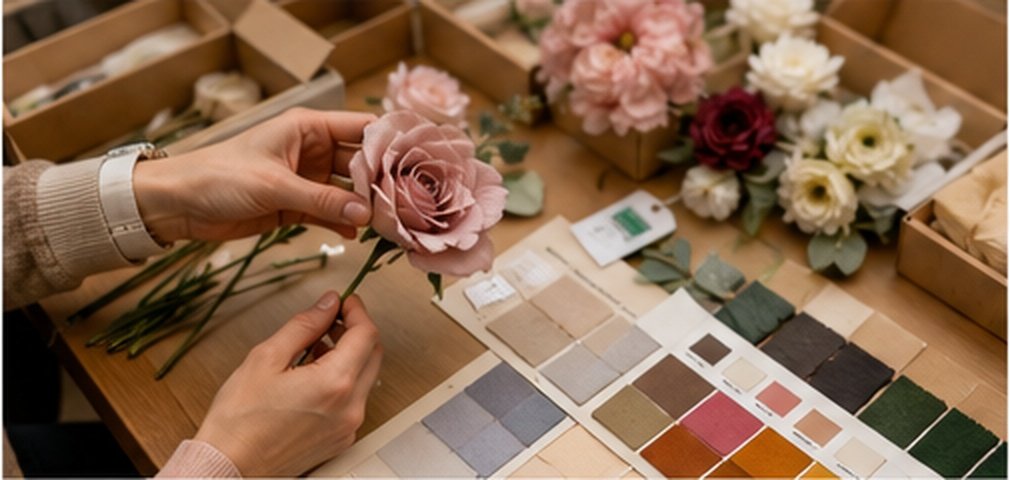
They Support Custom Color Palettes
Fabric can be dyed or printed in colors that may not exist naturally.
This is useful for weddings, branding, fashion, seasonal displays, and themed events. A buyer can coordinate flowers with fabric samples, packaging, table linens, or brand colors.
How to Judge the Quality of Fabric Flowers
Product photos can make low-quality flowers look better than they do in person. Use the following inspection points before purchasing.
Check the Petal Edges
Look closely at the edges of the petals.
Good edges should appear clean and appropriate for the flower species. Minor irregularity can look natural, but heavy fraying, visible threads, burned edges, or thick melted borders reduce realism.
Inspect the Color Transitions
A single flat color often looks manufactured.
Look for subtle variation between the center and edge, differences between the front and back of the petal, and small changes between individual petals.
The color should still be controlled. Random or excessive airbrushing can look less natural than a simple, accurate palette.
Examine Petal Thickness
Petal thickness should match the flower being represented.
A rose or magnolia can support a heavier petal, while poppies and sweet peas need lighter fabric. Thick fabric on a delicate flower makes the product look stiff.
Review the Flower Center
The center is often the weakest part of an artificial flower.
Check stamens, pollen details, seed structures, and the point where petals meet the center. Visible glue, oversized plastic parts, and unnatural colors can make an otherwise good flower look inexpensive.
Inspect the Stem
A good stem should support the flower head without appearing excessively thick.
Internal wire should allow adjustment while holding its position. The outer coating should hide the wire and connect naturally with leaves, buds, and branches.
Check the Arrangement From Several Distances
Evaluate fabric flowers from three viewing distances:
- Close range
- Normal room distance
- Across the room
A product for a wedding table or dining arrangement must perform well close up. Flowers used in a high retail display may not need the same level of fine detail.
Best Uses for Fabric Flowers
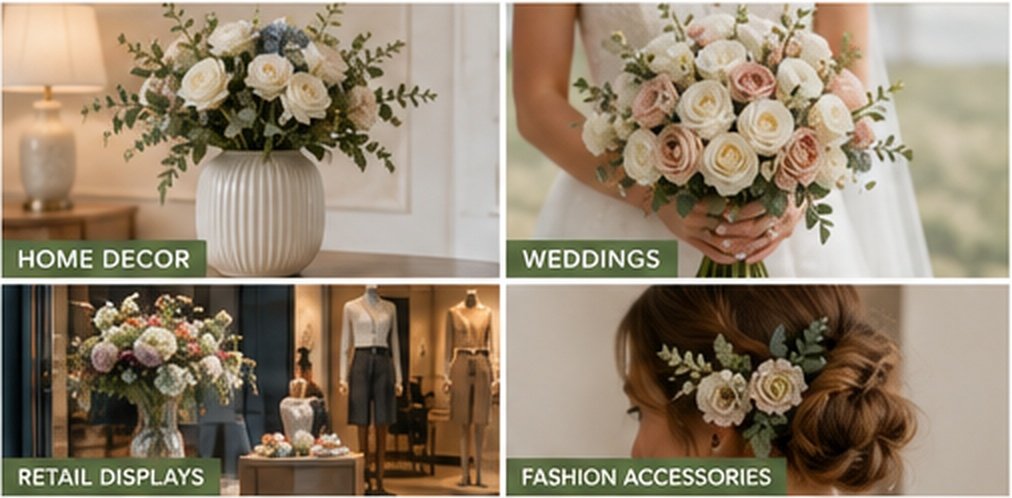
Home Interiors
Fabric flowers can add color to living rooms, bedrooms, entrances, dining rooms, and home offices.
For a natural result, choose arrangements that match the scale and style of the room. A large hydrangea arrangement suits a wide dining table, while one or two stems may work better on a bedside table.
CNGARDEN’s guide on how to style artificial flowers so they look real provides additional advice on stem height, foliage, vase selection, and arrangement balance.
Weddings
Fabric flowers are used for bridal bouquets, bridesmaid bouquets, boutonnieres, corsages, table centerpieces, arches, aisle decorations, and photo backdrops.
Their main advantages are planning flexibility and consistency. Arrangements can be completed before the wedding day without concerns about wilting.
They are also suitable for destination weddings where transporting or sourcing fresh flowers may be difficult.
However, wedding buyers should inspect the flowers under daylight, indoor event lighting, and camera flash. A surface that looks soft in person may appear shiny in photographs.
Seasonal Decorating
Fabric flowers can form part of a reusable seasonal system.
A neutral base of eucalyptus, fern, or understated greenery can remain in the vase throughout the year. Seasonal stems can then be exchanged:
- Tulips and cherry blossoms for spring
- Sunflowers and wildflowers for summer
- Dahlias and warm foliage for autumn
- Poinsettias and velvet magnolias for winter
Read CNGARDEN’s seasonal artificial flower decorating guide for ideas on reusable arrangements and storage.
Retail and Commercial Displays
Fabric flowers are useful for window displays, beauty stores, fashion shops, hotels, restaurants, cafés, spas, and event venues.
Commercial buyers should prioritize:
- Consistent batch color
- Replaceable stems
- Dust resistance
- Packaging quality
- Fire-performance documentation where required
- Easy installation
- Storage efficiency
- Repair options
A commercial installation may be viewed for months, so cleaning access should be considered during design.
Fashion and Crafts
Fabric flowers are widely used for:
- Hair accessories
- Brooches
- Hats
- Handbags
- Shoes
- Garment decoration
- Gift wrapping
- Wall art
- Wreaths
- DIY projects
Flowers intended for fashion need lighter weight and stronger attachment points than flowers intended for vases.
Gifts
A small arrangement can work as a housewarming, birthday, office, or thank-you gift.
Unlike fresh flowers, the recipient can keep the arrangement without immediate care. To make the gift more personal, select the recipient’s preferred colors or flowers and add a handwritten note.
How to Style Fabric Flowers So They Look Real
Bend the Stems Naturally
Straight, evenly spaced stems make an arrangement look artificial.
Use the internal wire to create gentle curves. Natural flowers usually lean, turn, and grow at different angles.
Avoid repeatedly bending one point too sharply, as this can damage the wire or outer coating.
Vary the Stem Heights
Cut or bend stems so the flowers sit at different heights.
Use larger flowers lower in the arrangement and lighter stems around the top and edges. This creates movement and prevents the arrangement from forming a flat circle.
Mix Buds, Open Flowers, and Foliage
Real plants do not produce every flower at the same stage.
Combine closed buds, partially opened flowers, full blooms, leaves, and branches. This variation makes the arrangement appear more botanical.
Use an Appropriate Vase
The vase should support the scale of the flowers.
A narrow vase works for a few long stems, while a large arrangement needs a stable container. Clear vases can expose artificial stems, so consider ceramic, metal, colored glass, or an opaque liner.
When using clear glass, decorative stones or a carefully designed artificial-water resin can conceal the base. Resin should be installed according to the manufacturer’s instructions.
Avoid Perfect Symmetry
Perfectly mirrored arrangements often look manufactured.
Use controlled asymmetry. One side may extend slightly higher, while another may have more foliage or a flower facing outward.
Combine Fabric Flowers With Other Materials
A premium arrangement may mix:
- Fabric flowers
- Molded leaves
- Dried branches
- Preserved moss
- Artificial berries
- Natural-looking twigs
- Paper flowers
- Decorative grasses
Mixed-material arrangements often look more realistic because each component uses a material suited to its form.
A Practical Fabric Flowers Buying Checklist
Before ordering, ask the following questions.
- What fabric is used for the petals?
- Are the flowers intended for indoor or outdoor use?
- Are the colors printed, dyed, sprayed, or hand-finished?
- Are the petals heat-shaped or molded?
- Can the stems be bent and reshaped?
- What are the flower-head and stem dimensions?
- Are stems sold individually or in bundles?
- Is the price per stem, bunch, box, or arrangement?
- Are different production batches color-matched?
- Can replacement stems be ordered later?
- How are the flowers packed to prevent crushing?
- Are samples available before a bulk order?
- Is flame-retardant documentation available if needed?
- What cleaning method does the supplier recommend?
- Can colors, labels, packaging, or stem lengths be customized?
For broader material comparisons, review CNGARDEN’s artificial plant materials buyer’s guide.
Wholesale and Commercial Purchasing Considerations
Wholesale buyers should evaluate more than the appearance of one sample.
A successful commercial order depends on repeatability. The approved sample should be documented with photographs, dimensions, materials, color references, packaging, and acceptable tolerances.
Important wholesale specifications include:
- Petal material and weight
- Flower-head diameter
- Total stem length
- Wire thickness
- Number of leaves and flower heads
- Color reference
- Packaging quantity
- Carton size
- Barcode and labeling
- Drop-test or transit requirements
- Fire-performance documentation
- Replacement-part availability
A sample viewed in a showroom may not represent every production batch. Ask how the supplier controls color, petal shape, stem length, and assembly.
For large events or retail programs, order a small pilot batch first. Use it to test unpacking time, reshaping, photography, installation, cleaning, and storage.
CNGARDEN’s artificial flower collection provides examples of artificial floral products and decorative formats available for home, craft, and commercial use.
Cost and Long-Term Value
Fabric flower prices vary significantly.
A simple craft flower may cost very little, while a detailed handmade stem or custom commercial installation can cost much more. The material name alone does not determine value.
When comparing options, consider:
- Number of petals
- Color complexity
- Hand finishing
- Mold detail
- Stem construction
- Flower size
- Packaging
- Customization
- Replacement availability
- Expected reuse
A lower-priced flower may be suitable for a large display viewed from a distance. A close-range bridal bouquet or luxury retail installation usually requires better details.
Long-term value depends on how many times the flowers are used. A wedding rental company may reuse a quality arrangement across multiple events, while a homeowner may rotate the same stems seasonally for years.
An illustrative comparison shows the principle:
- Arrangement A costs less but is replaced after one event.
- Arrangement B costs more but is reused for six events.
- Arrangement B may provide a lower cost per use, even though its purchase price is higher.
Storage and labor must also be included. A complex arrangement that takes hours to reshape may not provide better operational value than a simpler, more durable design.
Cleaning and Caring for Fabric Flowers
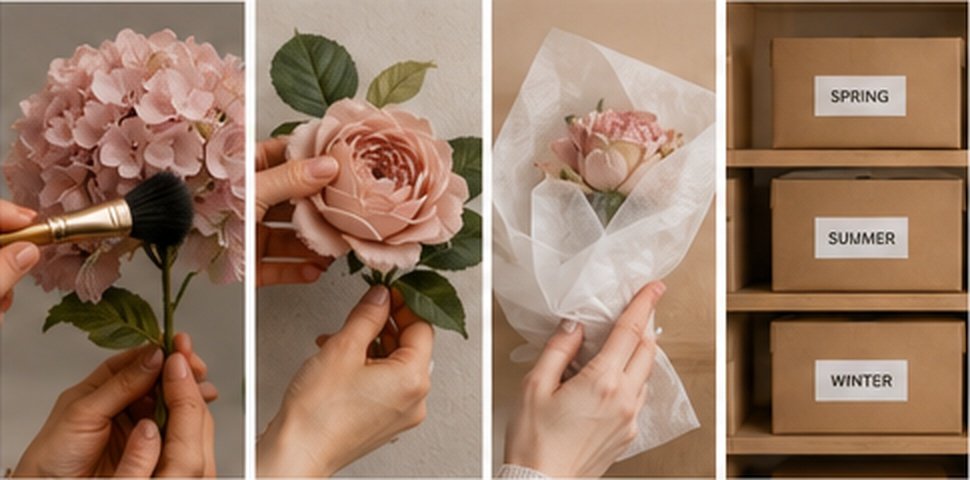
Fabric flowers collect dust, especially when displayed near windows, air vents, kitchens, or busy commercial areas.
Routine Dusting
Use a soft brush, microfiber duster, or low-suction vacuum with a brush attachment.
Support the flower head while cleaning. Do not pull the petals or place pressure on small centers and stamens.
Spot Cleaning
Test a hidden area before using moisture.
Use a lightly damp cloth or cotton swab for small marks. Avoid soaking the petals unless the supplier confirms that the material and color are water-safe.
Printed, sprayed, or hand-colored petals may stain or bleed when wet.
Reshaping
Steam may help remove some shipping creases, but it can also damage coatings, adhesives, or heat-shaped petals.
Use indirect, low-level steam only when recommended by the supplier. Keep the flower away from the steam source and reshape gradually.
Storage
Store fabric flowers in a dry, clean location away from direct sunlight.
Use boxes large enough to avoid crushing the flower heads. Wrap delicate blooms individually and label the boxes by season, color, or event.
Do not stack heavy objects on top of the cartons.
Indoor, Outdoor, and Fire-Safety Considerations
Most fabric flowers are designed for indoor use.
Sunlight can fade textile colors, while rain and humidity can affect fabric, wire, adhesives, and internal components. A flower described as “outdoor” should have clear information about UV exposure, moisture resistance, and expected use.
Do not assume that a water-resistant stem means the entire flower can remain outside.
Fire safety is especially important for flower walls, ceilings, arches, retail displays, restaurants, hotels, and event venues. Fire services warn that artificial flowers and their backings may contain combustible plastics, foams, and fabrics that can burn rapidly and produce significant smoke.
Commercial buyers should ask whether the material is inherently flame resistant, treated with a flame-retardant product, or tested to an applicable standard. Local authorities may require documentation for artificial foliage or flower installations in licensed premises.
Keep fabric flowers away from:
- Candles
- Open flames
- Fireplaces
- Hot lamps
- Heating elements
- Cooking equipment
- Indoor fireworks
- Unprotected electrical equipment
Requirements vary by country, building type, and installation. Large commercial projects should be reviewed by the venue, fire-safety professional, insurer, or local authority.
Sustainability and Environmental Claims
Fabric flowers should not automatically be described as sustainable simply because they can be reused.
Many products combine polyester, plastic, wire, foam, adhesive, pigments, and coatings. Mixed construction can make repair and recycling difficult.
Their environmental value depends on several factors:
- How long they are used
- How often they replace disposable arrangements
- Whether they can be repaired
- Whether components can be separated
- Packaging volume
- Shipping distance
- Recycled content
- End-of-life disposal
- Storage requirements
Buyers should ask for specific information rather than accepting vague terms such as “green,” “eco-friendly,” or “environmentally safe.”
The U.S. Federal Trade Commission’s Green Guides advise businesses to avoid broad, unqualified environmental claims that could mislead consumers. Claims about recycled content, recyclability, or environmental benefits should be specific and supported by evidence.
A more credible product description might say:
“Petals contain 30% verified recycled polyester.”
This is more useful than saying:
“Made from eco-friendly fabric.”
For buyers, long service life, replaceable stems, reduced packaging, and realistic reuse plans are often more meaningful than unsupported sustainability language.
Common Mistakes When Buying Fabric Flowers
Buying Only From Wide Product Photos
Wide images can hide frayed edges, flat coloring, visible glue, and weak centers.
Request close-ups and, for important orders, a physical sample.
Assuming All Silk Flowers Contain Silk
“Silk flower” is often used as a category name.
Always ask whether the petals are natural silk, synthetic silk, polyester, or another material.
Ignoring the Stem
A beautiful flower head with a weak or unrealistic stem limits how the product can be styled.
Inspect wire strength, leaf attachment, stem coating, and flexibility.
Using Indoor Flowers Outdoors
Outdoor exposure can cause fading, staining, corrosion, adhesive failure, and deformation.
Choose products specifically designed for the intended environment.
Ordering by Color Name Alone
Terms such as ivory, blush, champagne, burgundy, and sage vary between suppliers.
Use photographs, physical samples, or standardized color references for important projects.
Overfilling an Arrangement
Too many stems can make even premium fabric flowers look crowded and artificial.
Allow negative space and vary the heights and angles.
Forgetting Storage
Reusable flowers need space and protection.
Plan storage boxes, labels, shelving, and transport before buying large quantities.
Frequently Asked Questions About Fabric Flowers
Are Fabric Flowers the Same as Silk Flowers?
Not always.
Silk flowers may be made from natural silk, but the term is also commonly used for polyester and synthetic fabric flowers. Check the material specification before purchasing.
Which Fabric Is Best for Artificial Flowers?
Polyester provides a strong balance of cost, color options, shaping ability, and durability.
Synthetic silk is useful for soft, delicate petals, while cotton and velvet suit specific decorative styles. The best choice depends on the flower species and application.
Can Fabric Flowers Be Washed?
Some may tolerate gentle spot cleaning, but complete washing is risky.
Water can affect dyes, printing, adhesives, wire, and molded components. Follow the supplier’s instructions and test a hidden area first.
Can Fabric Flowers Be Used Outside?
Only products designed for outdoor exposure should be used outside for extended periods.
Confirm UV resistance, moisture performance, colorfastness, and stem construction. Covered outdoor use is less demanding than full exposure.
How Do You Make Fabric Flowers Look More Realistic?
Reshape the petals and stems, vary the height, mix buds with open flowers, add foliage, avoid perfect symmetry, and use an appropriate vase.
Close-range realism also depends on petal edges, centers, color gradients, and stem details.
Are Fabric Flowers Suitable for Weddings?
Yes.
They can be prepared in advance, matched to a specific color palette, reused, and kept as souvenirs. Review them under venue lighting and photography conditions before final approval.
How Long Do Fabric Flowers Last?
There is no universal lifespan.
Durability depends on material quality, sunlight, humidity, handling, cleaning, storage, and frequency of use. Indoor products that are cleaned and stored carefully can remain attractive for many years.
Final Buying Advice
Fabric flowers offer a useful balance between the softness of fresh flowers and the convenience of permanent decor.
The best products do more than copy a flower’s color. They reproduce its petal thickness, layered structure, center details, curves, and natural irregularity.
Start by defining the application. A wedding bouquet, retail display, home arrangement, fashion accessory, and outdoor installation all require different materials and construction.
Then evaluate:
- Petal material
- Edge quality
- Color variation
- Flower-center detail
- Stem strength
- Reshaping ability
- Cleaning requirements
- Storage needs
- Fire and outdoor documentation
- Cost per use
For home decoration, select a few convincing stems rather than a large quantity of average products. For weddings and commercial projects, order samples and test them under the actual lighting.
For wholesale purchasing, document the approved sample and confirm batch consistency, packaging, customization, and replacement options.
The next step is to choose two or three fabric flower styles that match your application and compare them in person. Review the petals at close range, bend the stems, examine the centers, and place the flowers in the intended vase or display.
Explore CNGARDEN’s artificial flower collection or read the complete artificial flowers guide for more product, material, and styling ideas.
 English
  Arabic
  Dutch
Dutch  German
  French
  Portuguese
  Spanish
  Russian
  Japanese
  Korean