

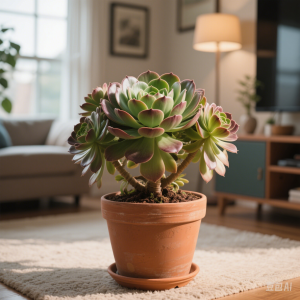
For those who truly love succulents, these remarkable plants represent far more than just pretty decorations. They’re living textbooks of evolutionary genius, each with incredible survival strategies honed over millennia. This deep dive reveals the hidden world of succulents that most growers never see – from their mysterious communication methods to their astonishing drought defenses. Evolutionary Marvels: How Succulents Conquered the Planet
Succulent plants have developed breathtaking adaptations:
1. CAM Photosynthesis – Unlike regular plants, most succulents only open their stomata at night to prevent water loss
2. Living Water Tanks – Some Adenium species can store 2,000 times their dry weight in water
3. Sunblock Chemistry – The white powder (farina) on Echeveria is actually natural UV protection
4. Temperature Tricks – Certain Lithops
can tolerate 60°C (140°F) by “retreating” underground
The Language of Succulents: Reading Their Secret Signals
Expert growers learn to interpret subtle signs:
– Stress Colors aren’t just pretty – they’re chemical sunscreens (anthocyanins)
– Leaf Windows on Haworthia act like fiber optic cables to channel light
– Root Communication – Studies show some succulents release chemical warnings when under attack
Extreme Survivalists: The World’s Toughest Succulents
Meet nature’s ultimate survivors:
1. Tylecodon paniculatus – Can lose all leaves and regrow from just the stem
2. Welwitschia mirabilis – Lives 2,000+ years in Namibian deserts
3. Dudleya farinosa – Survives salt spray on coastal cliffs
4. Aztekium ritteri – Grows just 1mm per year in limestone cracks
Cultivation Secrets From Nature
Recreate their native habitats:
– Mimic Microclimates – Use pebble trays for Conophytum (they grow in quartz fields)
– Seasonal Stress – Let your Sedum experience winter cold for better spring growth
– Wind Simulation – Gentle fan movement strengthens Senecio stems
The Future of Succulent Science
Cutting-edge research reveals:
– Biomimicry Potential – Studying succulent water storage for drought solutions
– Medical Breakthroughs – Aloe compounds showing anti-cancer properties
– Space Farming – Testing Opuntia for Mars agriculture
Become a Succulent Scientist
Turn your collection into a research lab:
1. Document stress responses with time-lapse photography
2. Experiment with alternative growing mediums (biochar, zeolite)
3. Track growth patterns under different light spectra
4. Participate in citizen science projects tracking climate adaptation
Remember: Every succulent in your collection is a masterpiece of evolution. By understanding their secret survival strategies, you’re not just growing plants – you’re preserving millions of years of natural wisdom.
 English
  Arabic
  Dutch
Dutch  German
  French
  Portuguese
  Spanish
  Russian
  Japanese
  Korean