

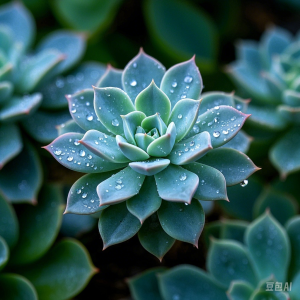
We are living in the renaissance of artificial plants. This isn’t hyperbole. The convergence of advanced manufacturing, sophisticated design, and a cultural shift toward practical beauty has propelled fake flowers from the decorative sidelines to the center stage of interior design. This is their moment.
What sparked this revival? A collective realization that our environments should serve us, not enslave us. The pursuit of the “perfect” Instagram-worthy jungle led many to plant graveyards on windowsills. Artificial flowers emerged not as a consolation prize, but as a brilliant alternative path to the same aesthetic goal: a serene, beautiful, green-filled space.

succulent plants
The Strategic Merits of Artificial Plants
Beyond “they don’t die,” modern fake plants offer strategic advantages for contemporary living:
-
Design Consistency: In an open-concept home or a commercial space, artificial greenery provides uniform texture and color that isn’t dependent on which corner gets morning light. Your design vision remains intact.
-
Allergy-Inclusive Design: They allow everyone to enjoy the psychological benefits of biophilia—our innate love of nature—without the sniffles, sneezes, or skin reactions that pollen and mold can cause.
-
The Traveler’s Ideal Companion: You can leave for a month-long trip without a moment’s worry. Your artificial flower arrangements will greet you with the same vibrancy upon your return.
-
Architectural Problem-Solving: Got a soaring two-story foyer that feels cold? A large-scale artificial plant or tree adds instant warmth and scale without the engineering feat of installing a living tree. Artificial hanging plants can soften hard angles and fill vertical space effortlessly.
The Aesthetic Schools of Fake Flowers
Today’s market caters to distinct design sensibilities. Which school do you belong to?
-
The School of Hyper-Realism: Followers of this school seek realistic fake flowers that could fool a botanist. They prize real look fake flowers with meticulous details—the fuzz on a stem, the translucence of a petal, the subtle variations in leaf color. Their mantra is “Is it real?”
-
The School of Stylized Expression: This school uses artificial flowers as pure elements of color, form, and texture. A fake flower bouquet here might feature blooms in a monochromatic, non-natural palette, or artificial greenery with a graphic, architectural shape. Their goal is mood, not mimicry.
-
The School of Collected Charm: Adherents create a look that feels gathered over time. They might mix a vintage artificial rose under a cloche with modern artificial hanging plants, or place fake vines in an antique pitcher. It’s eclectic, personal, and layered.
-
The School of Sustainable Statement: This newer school prioritizes artificial plants made from recycled materials, or uses them as permanent alternatives to resource-intensive live displays (like cut flowers). Their choice is an aesthetic and ethical one.
The Craft Behind the Craft: Making Realistic Fake Flowers
Creating the best artificial flowers is a multi-disciplinary craft blending art, science, and technology.
Phase 1: The Botanical Brief. Artists don’t just look at flowers; they deconstruct them. They study how a bud unfolds, how light filters through a leaf, how a stem bears weight. This research is foundational.
Phase 2: The Material Alchemy. Manufacturers now use:
-
UV-inhibited polymers for outdoor artificial flowers that resist fading.
-
Mixed-density foams and fabrics that replicate the varied firmness of different plant parts.
-
Weighted, poseable wire systems inside stems that allow for natural-looking arrangement.
Phase 3: The Artisanal Touch. After molding and assembly, each piece is hand-finished. This is where the soul is added: petals are separated, leaves are given unique angles, and subtle “imperfections” are introduced to break the sterile perfection of the machine-made base.
The Modern Procurement Playbook
Finding quality has never been easier, if you know where to look.
-
For the Tactile Shopper: Begin with a search for “fake plants near me” at higher-end home decor stores, not just big-box retailers. Feeling the materials is irreplaceable.
-
For the Research-Driven Buyer: Amazon artificial flowers sections are vast laboratories. Use the filtering tools, read reviews that mention “real touch” or “quality,” and always, always scrutinize customer-uploaded photos.
-
For the Project Planner: If you’re decorating an event space or multiple rooms, artificial flowers wholesale suppliers offer cost efficiency and consistency. They often sell to the public with reasonable minimums.
-
For the Discerning Collector: Seek out designers and boutiques that treat artificial flower arrangements as decorative art. These pieces are investments in lasting beauty.
Principles for Curating a Cohesive Artificial Plant Collection
-
Establish a Focal Point: Choose one standout artificial plant (a large tree, a dramatic artificial flower arrangement) as the anchor for a room. Build around it with smaller, supporting pieces of artificial greenery.
-
Vary Scale and Height: Combine floor plants, tabletop arrangements, and artificial hanging plants to lead the eye through the space and create visual interest at multiple levels.
-
Consider the Container as Part of the Composition: The pot or vase is half the design. A beautiful container elevates even a simple artificial flower. Match the container style to your overall decor theme.
-
Edit with Intention: Less is often more. A few well-chosen, high-quality fake plants will have more impact than a clutter of cheap ones. Give each piece room to breathe.
-
Light Them Thoughtfully: Avoid placing your artificial plant in direct, harsh sunlight that can create unnatural highlights. Use ambient or accent lighting to cast soft, realistic shadows.
The renaissance of artificial flowers is a testament to human ingenuity meeting human need. We desire the beauty and calm of nature, but we live in realities of limited time, light, and expertise. Fake plants bridge that gap with elegance and intelligence, proving that the smartest choice is often the one that simply, and beautifully, works.
 English
  Arabic
  Dutch
Dutch  German
  French
  Portuguese
  Spanish
  Russian
  Japanese
  Korean