

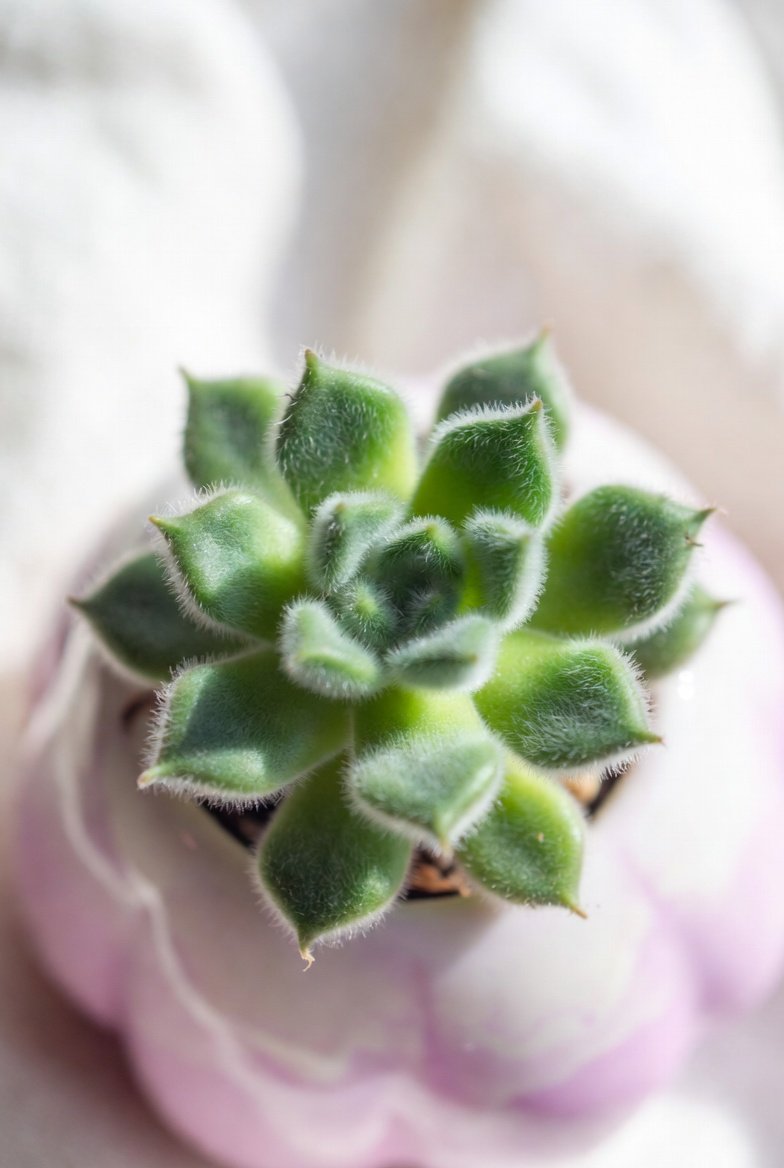
The market for 인공 식물 and 조화 ranges from convincing to obviously fake, and price isn’t always a reliable guide. Some expensive products are merely large; some mid-range products are excellently made. These are the actual markers that separate quality from disappointment.
1. Leaf Surface and Finish
Examine the upper side of leaves closely. Quality 가짜 식물 have a matte or very slightly sheen surface that mimics real foliage — not a glossy plastic finish. Run a finger across it: it should feel textured, not smooth and slippery. Visible veining pressed into the leaf surface is a strong positive indicator, as is color variation across the leaf rather than a single uniform tone.
2. Color Depth and Gradient
Artificial flowers should show color variation within individual petals — deeper at the base, lighter toward the edges. Flat, single-tone petals are a reliable sign of budget manufacturing. The same principle applies to leaves: quality 가짜 식물 have tonal variation that mimics how light falls on real foliage.
3. Stem and Branch Construction
Bend a stem. It should flex without cracking, hold its new position, and spring back partway — like real plant stems do. Rigid stems that don’t move, or wire stems that snap immediately, indicate poor construction. Check where branches meet the main trunk or stem: secure, reinforced joints indicate quality; loose connections that move freely suggest the piece won’t hold up.
4. Weight
Larger 인공 식물 made with quality materials have noticeable weight. PE components, steel wire frames, and quality soil simulation bases all add mass. A large fake plant that feels surprisingly light is almost always a budget piece with thin materials.
5. UV Rating for Sun-Exposed Positions
Any artificial plant going near a bright window or outdoors needs a specified UV rating. This should be explicit in product information, not vague. CNGARDEN specifies UV resistance across its applicable product lines, with stabilizers integrated into the materials rather than applied as surface coatings — a distinction that affects how long the protection actually lasts.
6. Foliage Density
Real plants have layered, overlapping foliage with visible depth when you look into the canopy. Fake plants that are sparse at the center or obviously under-leafed look artificial immediately. Check coverage from multiple angles, not just the front-facing view.
7. Pot and Base Quality
The vessel matters as much as the plant. A quality artificial plant in a cheap plastic pot loses half its visual impact. Conversely, a mid-range fake plant in a well-chosen ceramic or concrete planter can look considerably better than its price suggests. Factor the pot into your budget if the piece doesn’t come with one.
8. Brand Transparency
Reputable manufacturers publish material specifications, UV ratings, and intended use conditions. If a product listing lacks any technical detail, that’s usually because there’s nothing worth specifying. Brands like CNGARDEN provide product information that allows for genuine comparison — which is itself a signal of confidence in what they’re making.
Taking ten minutes to evaluate against these criteria before purchasing will consistently produce better outcomes than deciding on appearance in a photograph alone.
 English
  Arabic
  Dutch
Dutch  German
  French
  Portuguese
  Spanish
  Russian
  Japanese
  Korean