

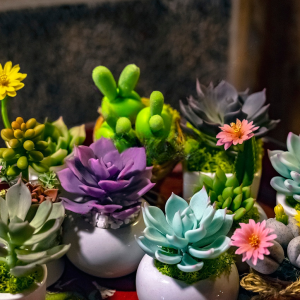
The journey of 人工植物 from kitsch to sophisticated is one of design’s quiet success stories. What began as convenient substitutes have transformed into artistic statements in their own right. Today’s フェイクフラワー don’t just mimic nature – they interpret it, celebrate it, and sometimes even improve upon it.
This transformation reflects broader changes in how we view decoration. Once seen as dishonest or “cheating,” 造花 are now appreciated for their honesty: they are exactly what they appear to be, forever.

The Philosophy of Permanent Beauty
Consider the Japanese concept of wabi-sabi – finding beauty in imperfection and transience. Now consider its opposite: the appreciation of permanent, crafted beauty. Artificial plants occupy this interesting space. They’re not trying to be imperfect like nature; they’re celebrating human craftsmanship’s ability to create lasting beauty.
For designers, this permanence is liberating. That perfect artificial flower arrangement over the mantel? It will look just as good in December as it did in July. The outdoor artificial flowers on your patio? They’ll welcome you home with equal vibrancy after a two-week vacation.
And in commercial design, this reliability is priceless. The 人工緑地 in a restaurant won’t drop leaves into soup. The 観葉植物 in a medical office won’t trigger allergies. They perform their aesthetic duty without drama.
The Design Language of 造花
Different styles communicate differently:
The Literalist approach seeks リアルなフェイクフラワー that could fool a botanist. These are exercises in technical mastery, often using real look fake flowers in settings where live plants would traditionally go.
The Stylist approach uses フェイクフラワー as color and texture elements. These arrangements might not exist in nature – imagine blue artificial roses or metallic 人工緑地 – but they serve the design vision perfectly.
The Architectural approach treats 人工植物 as structural elements. Large 観葉植物 become room dividers, artificial hanging plants define spaces, and にせのつる create living walls without the maintenance.
The Nostalgic approach embraces the history of 造花. Think of Victorian-style 造花 under glass domes, or mid-century modern 人工植物 in period-appropriate planters.
The Craft Renaissance
Creating quality 人工植物 has become a respected craft:
The Art of Observation:
Top manufacturers employ botanical artists who study living plants in minute detail – how light passes through a petal, how a leaf curls as it ages, how stems naturally bend toward light.
The Science of Simulation:
Advanced materials allow for:
-
Thermoplastic polymers with memory that return to shape after handling
-
Micro-perforated leaves that move subtly in air currents
-
Multi-density foams that replicate the firm-yet-yielding feel of living plants
The Technology of Production:
-
3D printing for intricate botanical details
-
Robotic painting for consistent, natural coloration
-
Computerized assembly ensuring every artificial flower meets exacting standards
The Educated Purchase
Knowing what to look for separates satisfying purchases from disappointments:
For Authenticity Seekers:
-
Examine the underside of leaves – realistic pieces have color variation here too
-
Check stem ends – they shouldn’t look freshly cut if mimicking mature plants
-
Feel the weight – quality 人工植物 have substantial heft
For Design Focus:
-
Consider silhouette first – how will it look across the room?
-
Think about scale – oversized 造花 make bold statements
-
Plan for lighting – some フェイクフラワー look better in natural light, others in artificial
For Practical Applications:
-
屋外の造花: Look for weatherproof ratings
-
造花卸売り: Verify lead times and shipping costs
-
Amazon artificial flowers: Check return policies before ordering multiples
The Stylist’s Secrets
Professional tricks for amateur spaces:
-
The Focal Point Formula: One spectacular 人工植物 per room, supplemented by simpler 人工緑地
-
The Height Hierarchy: Vary heights dramatically – floor plants, table arrangements, artificial hanging plants
-
The Color Connection: Pull one color from your フェイクフラワーアレンジメント into other room elements
-
The Seasonless Strategy: Choose 造花 that work year-round, then add seasonal accents
-
The Narrative Nuance: Create little scenes – a 人工植物 on a stack of books, にせのつる trailing from a shelf
The Ethical Design Choice
In an age of conscious consumption, 人工植物 offer compelling advantages:
-
No contribution to invasive species problems
-
Reduced demand for cut flowers with questionable labor practices
-
Durable goods that don’t enter waste streams quickly
-
Support for manufacturing innovation and jobs
For those concerned about plastic use, many manufacturers now offer recycling programs and use biodegradable materials where possible.
The Future of Fake Flowers
We’re seeing exciting developments:
-
Smart 人工植物 with integrated lighting
-
Customizable growth patterns – design your own fake plant shape
-
Scent-infused 造花 that release fragrance when touched
-
Interactive pieces that respond to environmental changes
The line between artificial and real continues to blur in fascinating ways.
The Final Bloom
造花 have completed their journey from substitute to specialty. They’re not for everyone or every situation, but for many modern design challenges, they’re not just an alternative – they’re the optimal solution.
In the end, good design serves people. It makes lives easier, spaces more beautiful, and days more pleasant. By that measure, today’s 人工植物 aren’t just acceptable – they’re exceptional. They represent a marriage of human creativity with human practicality, and isn’t that what good design should always be about?
 English
  Arabic
  Dutch
Dutch  German
  French
  Portuguese
  Spanish
  Russian
  Japanese
  Korean