

- The Touch Test: Nature Isn't Perfectly Smooth
- The Color Inspection: Look for Nature's Imperfect Palette
- The Weight & Temperature Test: Physics Doesn't Lie
- The Water Test (The Ultimate Giveaway)
- The "Too Perfect" Arrangement Analysis
- Advanced Forensic Tips
- Common Imposters & How to Spot Them
- When "Fake" is Actually Real: The Paint Job Scam
- Your Quick-Check Field Guide
Hey there, plant detective. So you’re standing in a home decor store, or maybe browsing online, and you see the most perfect succulent arrangement. The colors are vibrant, every leaf is flawless, and something in your gut whispers… too perfect? You’re probably right. As someone who has sourced thousands of plants for commercial installations and accidentally ordered my share of fakes early on, I’ve developed a foolproof system. Let me walk you through how to tell real vs fake succulents with near-perfect accuracy. No fancy tools needed—just your senses and a little know-how.

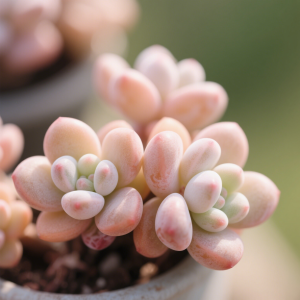
plantas suculentas
The Touch Test: Nature Isn’t Perfectly Smooth
This is your first and most reliable test. Gently touch the plant. I mean it—be respectful if it’s in a store, but make physical contact.
A Real Succulent:
-
Will have subtle textural variations. Run your finger along a leaf edge. Many have microscopic hairs or a slightly rough edge.
-
Feels firm yet slightly yielding, like a firm grape. There’s a living turgor pressure.
-
The surface might have a powdery coating called farina (especially on echeverias and graptoverias). This waxy, matte coating rubs off easily onto your finger. If you see perfect, shiny “farina” that doesn’t transfer? Major red flag.
A Fake Succulent:
-
Often feels uniformly smooth or has a synthetic, plastic texture. Some high-end fakes use vinyl or silk that’s too uniformly soft.
-
May feel unnaturally cool (like plastic) or have noticeable seam lines from the mold.
-
If it’s a fabric succulent, you might feel a wire inside the leaves or stem when gently squeezed.
Pro Tip: Try the “thumbnail test.” Gently press your thumbnail into the underside of a lower leaf (where it won’t show). A real leaf will show a slight indentation that slowly rebounds. A fake one won’t indent, or will feel obviously hard or crinkly.
The Color Inspection: Look for Nature’s Imperfect Palette
Manufacturers have gotten good at color, but nature is still more complex.
Real Succulent Color Tells:
-
Exhibits natural color gradients. A single leaf might shift from green at the base to pink at the tip, with the transition being subtle and blended.
-
Has minor imperfections: small scars, a slightly faded leaf here and there, or color variations between older and newer growth.
-
Shows sun stress colors that follow logic. Reds and purples typically appear on the sun-facing surfaces, not uniformly all over.
-
The underside of leaves is often a different, paler color than the top.
Fake Succulent Color Fails:
-
Colors are often too uniform and vibrant. Think “cartoon” levels of perfect color saturation.
-
Gradients are airbrushed or too perfectly symmetrical.
-
Every plant in an arrangement is identically colored—something almost never seen in nature.
-
Lacks the slight translucency that real, hydrated succulent leaves possess when backlit.
The Base & Stem Examination: Where Fakers Often Slip Up
This is the biggest giveaway. Turn the plant over or gently part the leaves to look at its base and stem.
What a Real Plant Shows:
-
A natural, woody stem or stem that has color variations (lignification). It may have old leaf scars where leaves fell off naturally.
-
At the base, you might see tiny, dry aerial roots or evidence of soil contact.
-
New growth emerges from the center and is often a different color/texture than mature leaves.
-
If potted in soil, the soil will look organic, might have minor algae on the surface, and will be consistent in moisture.
What a Fake Plant Betrays:
-
A perfectly green, plastic stem all the way down, often with a molded texture that repeats.
-
A metal wire stem wrapped in plastic or fabric (bend it gently to check).
-
Leaves that are all glued into a foam base or into perfectly uniform, machine-patterned positions.
-
“Soil” that is actually polyurethane foam, glued gravel, or suspiciously perfect moss. Tap it—it will feel hard and unyielding.
The Weight & Temperature Test: Physics Doesn’t Lie
Pick up the pot if you can. This is a huge clue.
A Real Potted Succulent:
-
Has substantial weight from soil, roots, and water in the tissues.
-
The pot feels bottom-heavy.
-
The plant and soil will generally be at room temperature.
A Fake Potted Succulent:
-
Is often suspiciously light. The bulk is foam and plastic.
-
May feel top-heavy if the pot is real but the plant is light fake material.
-
The leaves may feel cooler than the room if made of certain plastics or resins.
The Water Test (The Ultimate Giveaway)
This is your 99% certainty test, but only if you can do it discreetly or own the plant.
The Method: Place a single, tiny drop of water on a leaf and watch.
Real Succulent Reaction:
-
The water droplet will bead up due to the natural waxy coating.
-
It will either sit on the surface or roll off slowly.
-
The leaf will not absorb the water immediately. Over minutes, the bead may shrink very slightly.
Fake Succulent Reaction:
-
On plastic, the water may sheet out or form a flat puddle.
-
On fabric or latex, the water will be absorbed immediately, darkening the spot.
-
If painted, the water might cause the paint to run or show a change in sheen.
Warning: Only do this on a plant you own or with permission, as it can damage some high-end faux finishes.
The “Too Perfect” Arrangement Analysis
Examine the entire arrangement. Nature doesn’t do perfect symmetry.
In a Real Arrangement:
-
Plants grow toward the light, so there will be slight directional growth.
-
Some leaves may have minor nicks or imperfections.
-
Different plants in a combo pot will have slightly different growth rates and health.
-
Soil levels might vary slightly.
In a Fake Arrangement:
-
Every element is symmetrically and perfectly placed. No leaf is out of order.
-
All plants are identical in size, color, and “bloom” stage.
-
Often uses colors that don’t exist together in nature (like a bright blue echeveria next to a neon orange one).
-
The arrangement looks exactly the same from every angle.
Advanced Forensic Tips
For those really tricky high-end replicas:
-
Check for UV Fading: If the plant is in a sunny window but shows zero fading on the sun-facing side, it’s likely artificial. Real plants change with light exposure.
-
The Bloom Test: Flower stalks on fake plants are often permanent, perfectly colored, and made of plastic or silk. Real succulent flowers are delicate, often have a growth cycle, and may wilt. A hot glue gun blob at the base of a “flower” is a dead giveaway.
-
Dust Pattern: Real plants don’t collect dust uniformly. Fake ones often do, especially on upward-facing surfaces.
Common Imposters & How to Spot Them
Some species are faked more often. Know your suspects:
-
“Blue” Echeverias: A vibrant, unreal powdery blue is common in fakes. Real blue succulents are more muted.
-
“Flowering” Hens and Chicks (Sempervivum): Fakes often have a perfect, permanent pink flower in the center. Real ones flower once, then that rosette dies.
-
“Rainbow” Colored Succulents: If it looks like it’s been dipped in multiple neon paints, it’s almost certainly fake. Real color changes are gradual and natural.
When “Fake” is Actually Real: The Paint Job Scam
A disturbing trend: real, living succulents are sometimes spray-painted with garish colors. Here’s how to spot this cruel practice:
-
Look for uniform color that coats every surface, including hidden parts of leaves.
-
See if new, unstained growth is emerging from the center in a different color.
-
The paint often gives the plant a stiff, unnatural look and feels tacky.
Your Quick-Check Field Guide
Next time you’re unsure, run this mental checklist:
-
TOUCH: Does it have texture, farina, and a living firmness?
-
LOOK AT THE BASE: Is there a real stem, soil, and natural asymmetry?
-
HEFT THE POT: Does it have the weight of soil and water?
-
ANALYZE COLOR: Are there natural gradients and imperfections?
-
SCAN THE ARRANGEMENT: Is there uniform, unnatural perfection?
Remember, high-quality suculentas artificiales have their place—in low-light rooms, for people with severe allergies, or in commercial spaces where maintenance is impossible. There’s no shame in choosing them intentionally. The problem is paying real plant prices for a fake, or expecting a living companion and getting plastic.
Armed with these tips, you’ll confidently separate the living from the imitation every single time. Trust your senses—you’re more equipped to spot a fake than you think. Now go forth and be a savvy plant shopper.
 English
  Arabic
  Dutch
Dutch  German
  French
  Portuguese
  Spanish
  Russian
  Japanese
  Korean