

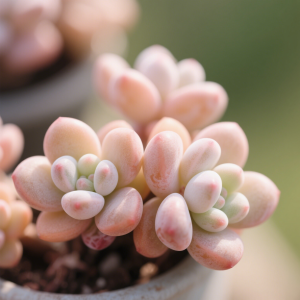
Have you ever brought home an adorable succulent, only to find it dropping leaves, rotting at the roots, and ending up as an empty pot within a few weeks? Don’t worry—this is a phase almost every succulent enthusiast goes through. As someone who has been growing succulents for five years, I’d like to share some practical tips on succulent plant care to help you easily avoid common pitfalls.

succulent plants
Let’s start with the most critical aspect—watering. I’ve noticed that many beginners end up overwatering their succulents, which is often the main cause of their demise. Remember, succulents dislike frequent watering! My approach is to follow the “soak and dry” method. Specifically, wait until the soil is completely dry before watering thoroughly, until water flows out of the drainage hole at the bottom of the pot. How can you tell if the soil is dry? Here’s a little trick: insert a bamboo skewer into the soil, leave it for a few minutes, and then pull it out. If the skewer comes out dry, it’s time to water.
Speaking of watering, we must also talk about soil mix. Many friends ask, “Why does my succulent still rot even when I use specialized succulent soil mix?” The issue might be insufficient soil aeration. I recommend adding some granular materials to store-bought succulent soil, such as perlite, vermiculite, or akadama. My personal recipe is half peat soil and half granular material, which ensures the soil retains some moisture while remaining breathable, effectively preventing succulent root rot.
Lighting is another key factor for maintaining vibrant succulents. I’ve seen many friends place their succulents in poorly lit indoor spots, resulting in “etiolation”—where the stems become elongated and the leaves sparse. Most common succulent varieties, such as Echeveria derenbergii and Echeveria chihuahuaensis, need at least 4–6 hours of direct sunlight daily. If you’re growing succulents on a balcony, a south-facing one is ideal. However, be cautious of intense midday sun in summer, which can scorch the leaves, so some shading may be necessary.
Now, let’s talk about propagation—this might be the most joyful part of growing succulents! Succulent plant propagation mainly includes leaf cuttings and stem cuttings. When propagating from leaves, gently twist the leaf to ensure the growth point remains intact. After removing the leaf, place it in a cool, well-ventilated spot to allow the wound to callus over. Once healed, lay it flat on the soil surface. Remember not to water immediately—wait until new roots appear before misting lightly. Through succulent propagation, turning one plant into many is truly a dream come true!
For those just starting out, I recommend beginning with some easy-to-grow succulent varieties. Plants like Graptoveria ‘Titubans’, Sedum adolphi, and Sedum rubrotinctum are not only affordable but also very resilient. Once you’ve gained some experience, you can try cultivating rarer varieties. Remember, it’s important to choose varieties that suit your growing environment—don’t blindly chase after rare species.
The choice of containers also matters. I strongly recommend using succulent pots with drainage holes. Many people love using cute glass containers or ceramic cups without drainage holes, but this is essentially setting up their succulents for failure. Without drainage holes, water can easily accumulate, leading to root rot. If you really love a container without drainage holes, I suggest adding a thick layer of clay pebbles at the bottom as a drainage layer.
Lastly, I’d like to share a detail many people overlook—ventilation. Especially in summer, good airflow can effectively prevent pests and diseases. I recommend opening windows for ventilation when the weather is nice, and if possible, using a small fan to improve air circulation.
 English
  Arabic
  Dutch
Dutch  German
  French
  Portuguese
  Spanish
  Russian
  Japanese
  Korean