

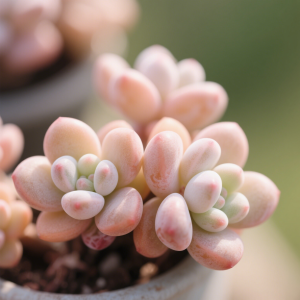
A quiet green revolution is unfolding in contemporary design. When you step into modern offices, boutique hotels, or stylish residences, those perpetually pristine succulents prompt a compelling question: Are these living plants or masterful replicas? In reality, high-quality artificial succulent plants have transcended the limitations of traditional imitations to become the most versatile elements in a designer’s toolkit.
This transformation began with advancements in materials science. The new generation of fake succulents utilizes bio-based polymers and advanced elastomer composites that not only perfectly replicate the characteristic plumpness of succulent plants but also accurately recreate leaf venation through micro-injection molding technology. Professional botanists participate in color development, ensuring each leaf displays the natural gradients and sun exposure marks found in living specimens. This dedication to detail allows artificial succulent pots to achieve visual and tactile authenticity that challenges perception.
Commercial demand for bulk succulent plants has catalyzed innovative supply chain models. Large commercial complexes procure thousands of uniformly sized large artificial succulents through artificial succulent wholesale channels to create cohesive interior landscapes. Notably, modern succulent planters have undergone parallel innovation—modular planting systems enable maintenance staff to quickly refresh arrangements, keeping space greenery perpetually vibrant. These artificial succulent arrangements not only enhance environments but also contribute significantly to building sustainability certifications.
At the micro scale, mini artificial succulents are redefining desktop greenery. These exquisite creations, measuring just 2-3 centimeters in diameter, are entering households through bulk succulent plants purchasing models. Creative professionals combine various small artificial succulents in custom succulent planters to craft unique miniature landscapes. Educational institutions utilize these durable teaching tools to demonstrate plant morphology without concerns about maintenance.
The hospitality and retail sectors particularly value the practicality of artificial succulent arrangements. In upscale restaurants, carefully designed potted succulent plants withstand constant air conditioning without wilting, while shopping mall installations featuring large artificial succulents become popular photo spots that attract customers. These commercial applications rely on stable artificial succulent wholesale supply chains to ensure immediate replacement or expansion of decorative elements.
Contemporary artificial succulent plants embrace an ecological authenticity in their design philosophy. Leading manufacturers have moved beyond simply replicating common varieties, instead collaborating with botanists to develop biomimetic versions based on endangered succulent species. This approach satisfies collector enthusiasm while avoiding pressure on fragile ecosystems, elevating fake succulents from mere decorations to vehicles for conservation awareness.
With advances in smart manufacturing, personalized succulent planters and customized 人工多肉植物 combinations are emerging as the latest trend. Consumers can now design exclusive artificial succulent pots through digital platforms, selecting specific variety mixes and container pairings to enjoy creating unique interior landscapes. This flexible production model, optimized through artificial succulent wholesale networks, is making personalized customization accessible to mass markets.
From Tokyo’s Ginza boutiques to Dubai Mall’s sky gardens, from Silicon Valley tech campuses to Stockholm’s eco-residences, artificial succulent plants are globally redefining the boundaries between artificial and natural. They require no sunlight, water, or specialized care, yet provide modern urban dwellers with continuous psychological comfort—perhaps the essential solution for future urban greening.
 English
  Arabic
  Dutch
Dutch  German
  French
  Portuguese
  Spanish
  Russian
  Japanese
  Korean