

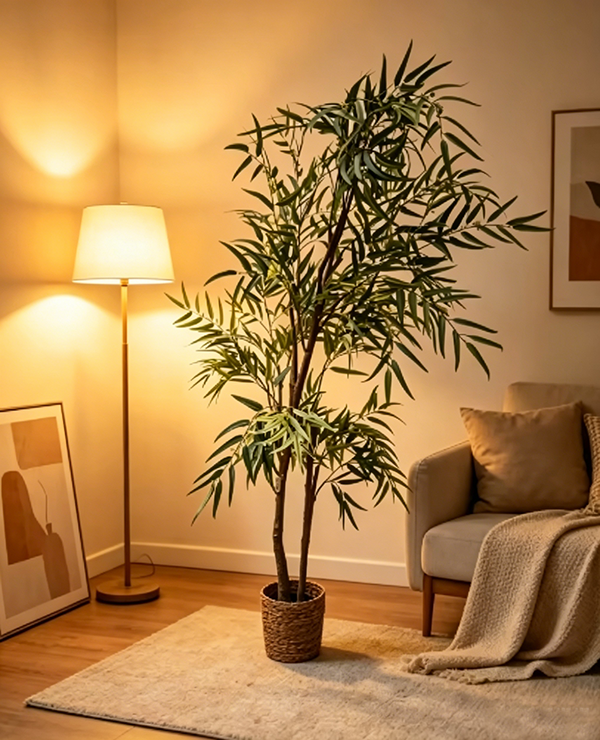
Most buying decisions about 人工植物 are made on appearance alone. That’s reasonable, but appearance at the point of purchase doesn’t tell you much about how a product will hold up six months later. The materials and construction methods underneath determine longevity, UV resistance, colorfastness, and how convincing the product remains over time.
PE vs. Fabric: Which Material for Which Purpose
Polyethylene (PE) molded components are the current benchmark for realistic foliage. The process involves creating a mold directly from a real leaf or plant specimen, capturing every surface detail — veining, texture, natural curvature. The resulting PE component, when properly finished with multi-layer pigment, is nearly indistinguishable from the original.
PE is also the right material for outdoor-rated 人工植物. When UV stabilizers are blended into the polymer at the manufacturing stage, the resulting material resists sun degradation for years rather than weeks. This is meaningfully different from surface UV coatings that eventually wear off.
Fabric and silk blends excel for 造花 — petals, fine leaf structures, and delicate botanical details where PE would look too solid. Layered polyester with gradient dyeing creates the color depth and slight translucency that makes a fabric rose petal convincing. The critical quality marker is colorfastness treatment: UV-stabilized fabric retains color near bright windows; untreated fabric fades within months.
EVA Foam: The Succulent and Tropical Specialist
Ethylene-vinyl acetate (EVA) foam is used for succulent leaves, tropical foliage, and any leaf form that needs the slightly waxy, semi-rigid character of real tropical plants. It takes pigment well, can be finished to a realistic matte or subtle gloss, and holds its three-dimensional shape without the stiffness of rigid plastic.
CNGARDEN uses EVA components across its tropical and succulent ranges, layered with multiple pigment finishes to achieve the color depth that distinguishes quality 観葉植物 from flat-looking budget alternatives.
Stem and Branch Construction
The stem framework determines how an 人工植物 looks when arranged and how long it lasts. Steel wire cores wrapped in fabric or bark-finish coatings allow bending and repositioning without snapping — essential for achieving natural-looking arrangements. Rigid plastic branches can’t be adjusted and break when stressed.
Check connection points between branches and main stems. Well-made 観葉植物 have secured, reinforced joints. Budget pieces often have components that pull free with minimal force.
What UV Resistance Actually Means
UV resistance in 人工植物 means resistance to the specific wavelengths of sunlight that break down polymer chains and bleach colorants. There are two approaches: surface coatings (less durable, cheaper) and stabilizer additives blended into the base material during production (more durable, the approach used by quality manufacturers including CNGARDEN).
For any 人工植物 destined for a bright room or outdoor position, UV-stabilized materials aren’t optional. The difference between treated and untreated product over a two-year period near a south-facing window is dramatic.
Eco-Friendliness: The Honest Picture
PE, polyester, and EVA are petroleum-derived plastics. That’s a real environmental consideration. The mitigating factor is lifespan — a quality 人工植物 used for ten years has a different lifecycle footprint than repeatedly purchasing and discarding live plants or cheap artificial replacements.
Some manufacturers are actively working on the materials side. Recycled PE content is appearing in more product lines, including parts of CNGARDEN’s range, and the industry is gradually moving toward more sustainable base materials. It’s a direction worth supporting by choosing manufacturers who are investing in it.
 English
  Arabic
  Dutch
Dutch  German
  French
  Portuguese
  Spanish
  Russian
  Japanese
  Korean