

- Why Artificial Plants for Bathrooms Make Sense
- What to Look for Before Buying
- Seven Best Artificial Plant Styles for Bathrooms
- Where to Place Artificial Greenery
- Humidity, Ventilation, and Mold Prevention
- How to Clean Artificial Plants for Bathrooms
- Cost, Quality, and Long-Term Value
- Common Styling Mistakes
- Artificial Plants Versus Live Bathroom Plants
- Bathroom Artificial Plant Buying Checklist
- Final Recommendations
- Sources
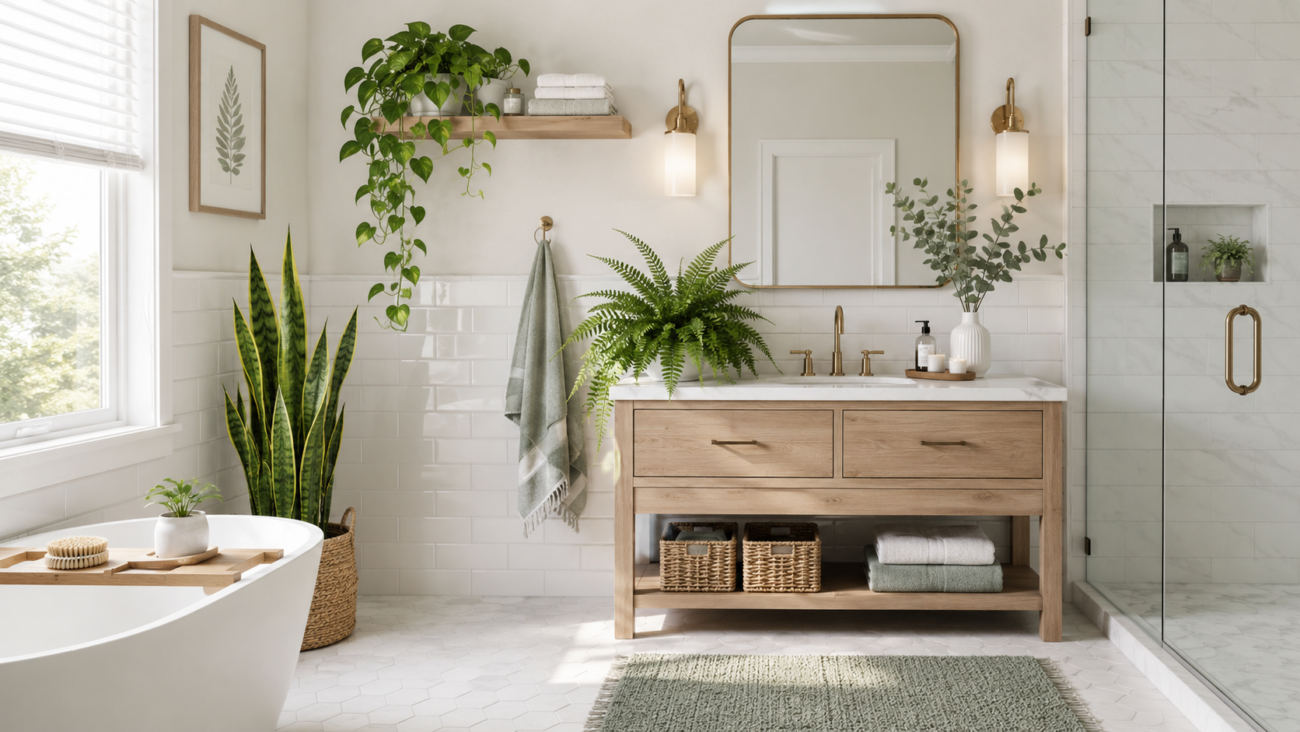
Bathrooms need warmth and color, yet they are difficult places for living greenery. Light may be weak, temperatures change quickly, and moisture collects on leaves, shelves, and windows. Many homeowners therefore search for artificial plants for bathrooms that look convincing without creating another maintenance problem.
This guide explains which styles and materials work best, where to place them, what quality details justify a higher price, and how to keep them clean in a humid room. You will also learn when a live plant is still the better choice. The goal is a bathroom that feels calm and natural while remaining practical to use and easy to maintain.
Why Artificial Plants for Bathrooms Make Sense
A bathroom often gives a live plant inconsistent conditions. A bright shower room may become hot and humid for twenty minutes, then cool and dark for the rest of the day. A windowless powder room may offer no useful daylight at all. Artificial greenery removes the watering and light variables while preserving the visual softness people want.
That does not mean every fake plant belongs near a shower. Humidity can leave mineral spots on foliage, dust can stick to damp surfaces, and inexpensive paper-wrapped stems may swell or discolor. The best artificial plants for bathrooms use washable leaves, stable color, and pots that tolerate occasional splashes.
Artificial greenery is also useful for households that travel, rental properties between guests, and commercial washrooms that need a consistent appearance. It will not outgrow a shelf or drop soil on a vanity. For a room where hygiene and predictable presentation matter, those are meaningful advantages.
What to Look for Before Buying
Choose Moisture-Tolerant Materials
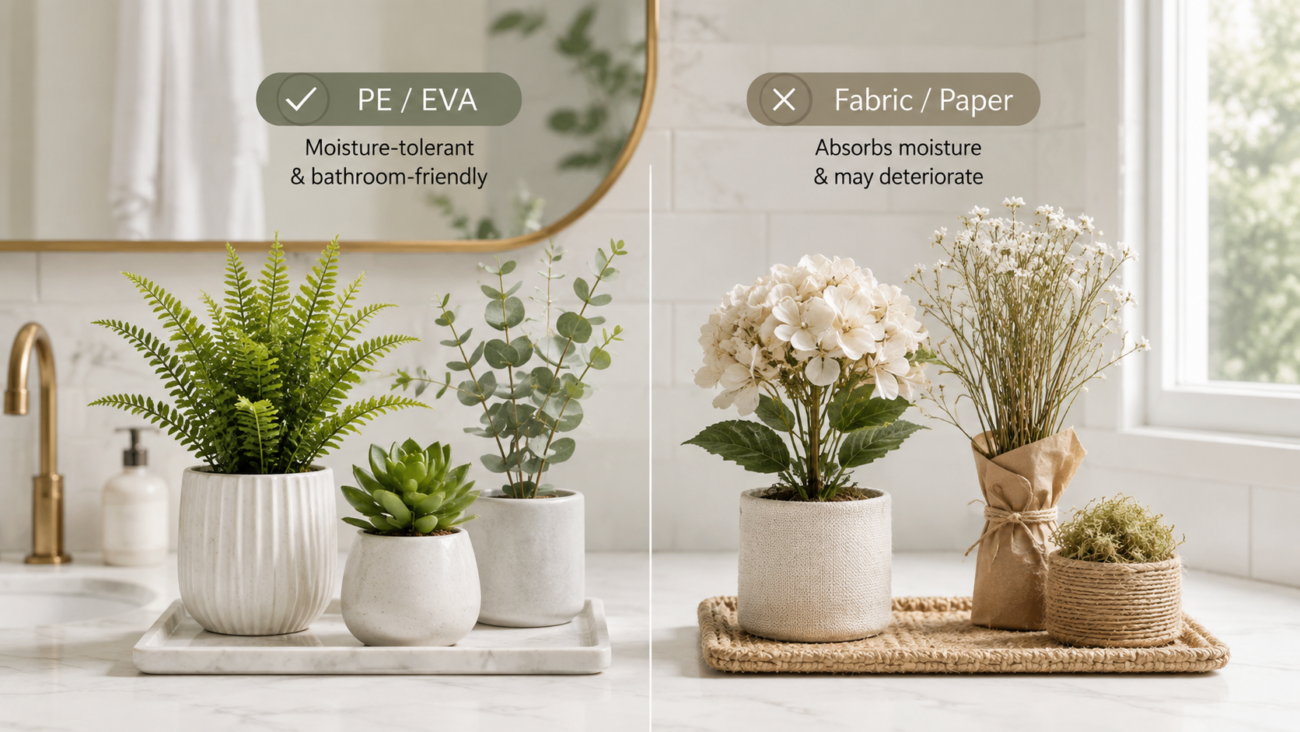
Polyethylene, usually shortened to PE, is a molded plastic commonly used for realistic leaves. Good PE foliage can reproduce veins, curved edges, and varied leaf thickness while remaining easy to wipe. EVA foam is soft and useful for fleshy succulent leaves, although it may show dents when squeezed or stored poorly.
Polyester fabric can create delicate leaves and flowers, but exposed cut edges absorb more moisture and collect dust. Reserve fabric-heavy arrangements for a dry vanity or enclosed shelf rather than the shower ledge. Avoid untreated paper, natural moss, jute wrapping, and unfinished wood where regular steam or splashes are expected.
Inspect Color and Surface Detail
Real leaves rarely have one flat shade. Look for controlled variation between older and newer leaves, subtle veining, and a finish that is not uniformly glossy. A small amount of sheen suits tropical plants, but a mirror-like surface usually looks plastic under bathroom lighting.
Check the underside as well as the top. Better artificial plants for bathrooms carry color and texture around the entire leaf instead of revealing a pale molded back. Visible mold seams, identical leaf angles, and bright green stems are common signals of a budget construction.
Check the Internal Structure
Wire inside a stem lets you change the plant from a compressed shipping shape into a natural silhouette. The wire should bend smoothly and remain hidden. Branch joints should feel secure, especially on trailing plants that may be moved whenever the shelf is cleaned.
For floor plants, examine the trunk and base. A weighted nursery pot is more stable than a thin decorative pot, but it should still sit inside a water-resistant cachepot. If a tall plant can tip when a towel brushes it, it is not suitable for a busy family bathroom.
Seven Best Artificial Plant Styles for Bathrooms
1. Trailing Pothos for High Shelves
A trailing pothos softens hard tile and uses vertical space without taking over the vanity. Place it on a cabinet, recessed shelf, or wall ledge where the vines can fall freely. Choose irregular vine lengths and leaves in two or three sizes to avoid a curtain-like shape.
This is one of the most versatile artificial plants for bathrooms because it works in modern, farmhouse, and traditional interiors. Keep the lowest leaves clear of wet towels and direct shower spray. A removable inner pot makes periodic cleaning much easier.
2. Ferns for Soft, Full Texture
Ferns create volume without relying on flowers. They look especially convincing near frosted glass, pale stone, and warm wood tones. A medium fern can fill an empty corner on a wide counter, while a compact maidenhair-style plant suits a narrow shelf.
Fine fronds collect more dust than broad leaves, so a fern needs more frequent rinsing or gentle wiping. Select flexible molded fronds rather than fragile fabric tips. Spread the stems in several directions after unpacking and leave some negative space between them.
3. Eucalyptus for Minimalist Bathrooms
Eucalyptus brings a muted gray-green color that pairs well with white, beige, charcoal, and brushed metal. Three to five stems in a simple ceramic vase often look more refined than a dense bouquet. It is a strong choice when the room already contains many patterns or decorative objects.
Do not confuse decorative artificial eucalyptus with aromatherapy products. Fake stems provide appearance, not the properties of essential oil. If fragrance is desired, use a product intended for that purpose and follow its safety directions rather than applying oil to plastic foliage.
4. Orchids for a Polished Vanity
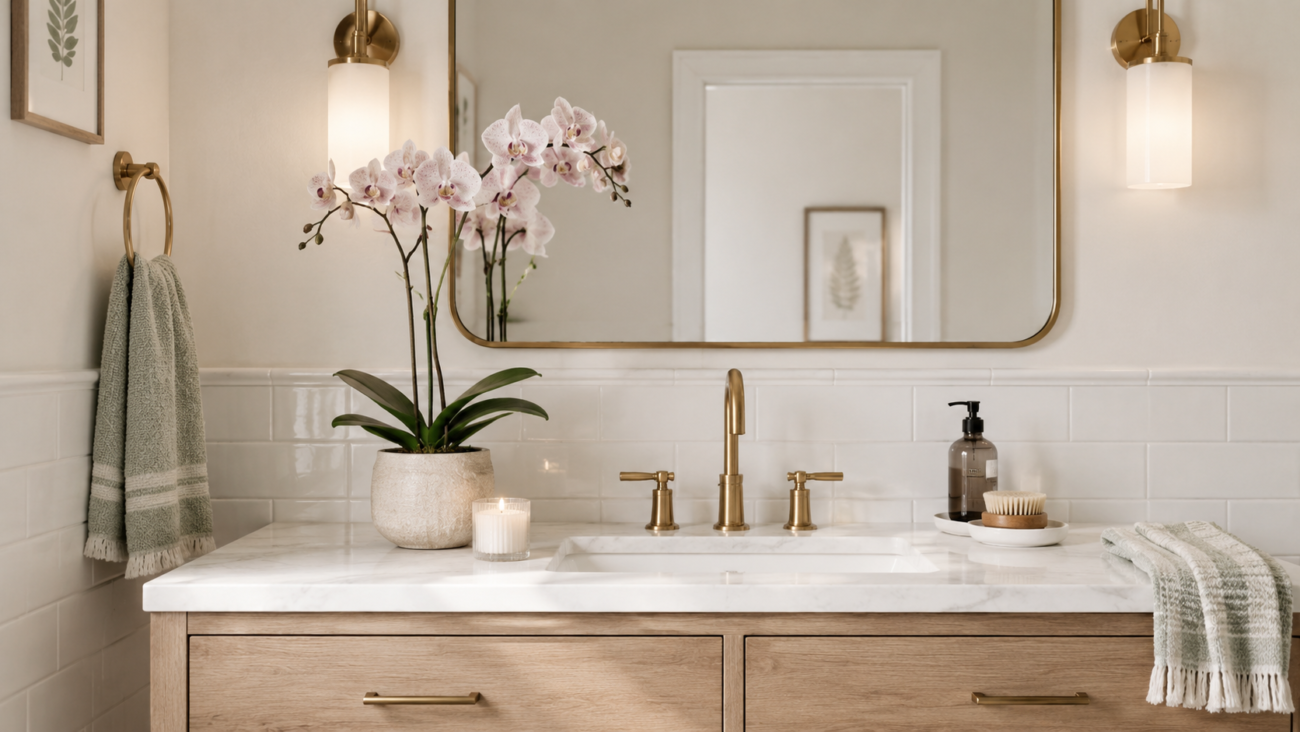
An artificial orchid provides height and a precise focal point for a guest bathroom. Look for petals with gentle color variation, buds at different stages, and roots or bark that do not appear perfectly arranged. White and pale pink are easy to coordinate; saturated colors demand more restraint elsewhere.
Orchids are best on a relatively dry vanity, not inside a shower enclosure. Fabric petals can hold dust and water spots. A compact arrangement with one or two flowering stems usually appears more believable at close viewing distance than an oversized display.
5. Snake Plants for Floor Corners
A snake plant has an architectural outline that fits a narrow floor area. Its upright leaves do not interfere with cabinet doors or walking paths. Choose a height that relates to the vanity: roughly knee to waist height works in many average bathrooms, while a larger room can support a taller specimen.
Broad molded leaves are simple to wipe, making snake plants practical artificial plants for bathrooms. Quality depends heavily on leaf variation. Avoid models in which every blade has the same height, curve, and printed pattern.
6. Succulents for Small Ledges
Artificial succulents fit window ledges, medicine-cabinet shelves, and the back of a toilet tank. Their compact form is useful where a trailing vine would interfere with daily tasks. A single convincing rosette in a restrained pot usually looks better than a crowded tray of many unrelated species.
EVA and molded PE can reproduce thick leaves well. Look for a matte bloom, restrained edge color, and an asymmetrical rosette. Decorative gravel should be fixed securely so it cannot spill into a sink or become accessible to small children.
7. Bamboo or Palm for Larger Rooms
A tall bamboo or palm can balance a freestanding tub or fill the space beside a linen cabinet. It creates more impact than several small objects and helps a large bathroom feel furnished. Allow enough clearance for leaves to spread without touching frequently wet walls.
Large artificial plants for bathrooms need a weighted base and a pot proportional to their height. Measure the floor area, doorway, and ceiling before ordering. A plant that arrives in sections should have concealed joints and branches that can be reshaped.
Where to Place Artificial Greenery
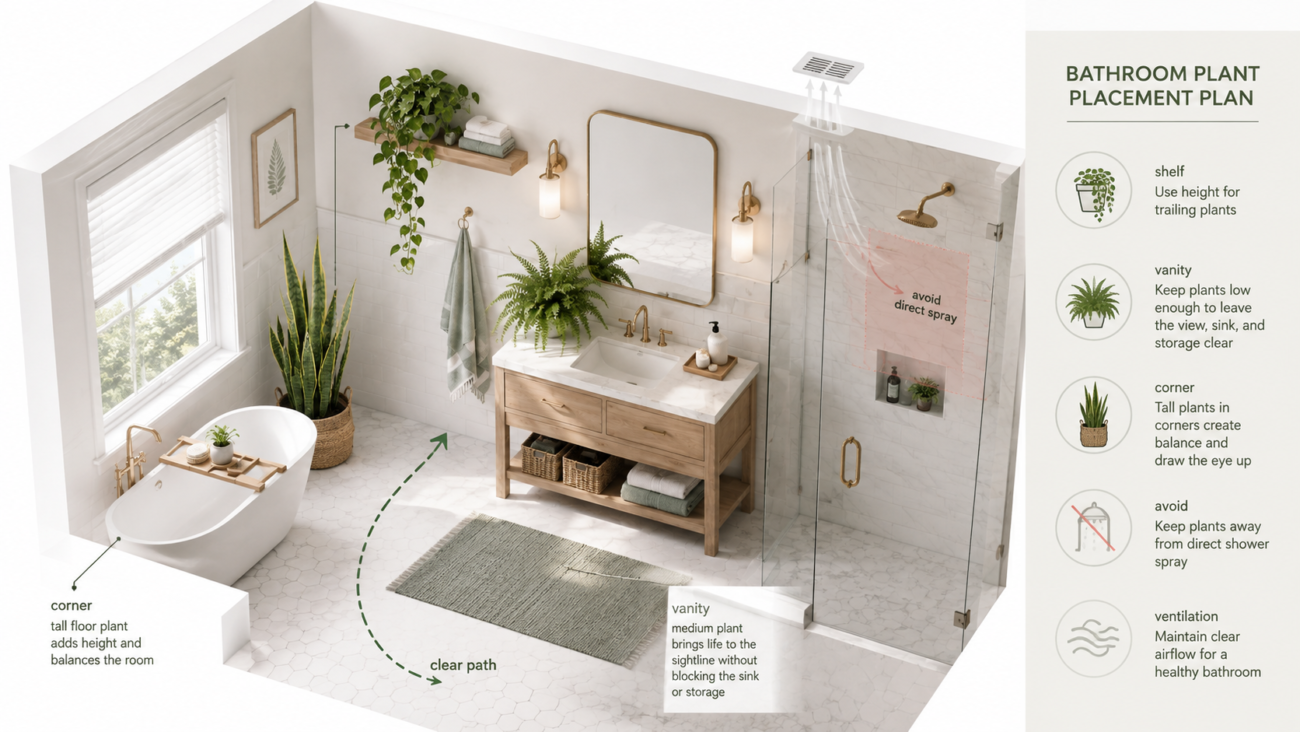
Start with the viewing angle. A floor plant should improve the sightline from the doorway without narrowing the route to the shower, toilet, or storage. Countertop plants should not compete with soap, toothbrushes, or grooming appliances. If an object must be moved every morning, its placement is not sustainable.
Keep foliage away from open flames, hot styling tools, radiators, and heating vents. Do not cover an exhaust grille or place stems where they can fall into a sink. In homes with children or pets, secure tall pots and avoid loose decorative stones.
Direct shower spray is a poor location even for washable plastic. Water can remain inside branch sockets or beneath artificial soil, creating odor and making cleaning harder. Position artificial plants for bathrooms where they receive visual exposure rather than constant water exposure.
Humidity, Ventilation, and Mold Prevention
Artificial plants do not need humidity, and they do not solve a moisture problem. The U.S. Environmental Protection Agency advises ventilating bathrooms during use and drying damp surfaces because shower humidity can support mold growth. The agency also recommends running an exhaust fan or opening a window when showering.
The U.S. Centers for Disease Control and Prevention advises keeping household humidity no higher than 50 percent and using bathroom exhaust fans that vent outdoors. These recommendations protect the room and its contents; they are not special maintenance rules for fake plants. If condensation regularly covers walls or windows, address ventilation before adding more decor.
Dust and soap residue on foliage can provide a surface for grime even though plastic itself is not food for mold. Inspect the underside of leaves, pot rims, and artificial soil. If you see recurring growth, remove the arrangement, clean the surrounding surface, and correct the moisture source.
How to Clean Artificial Plants for Bathrooms
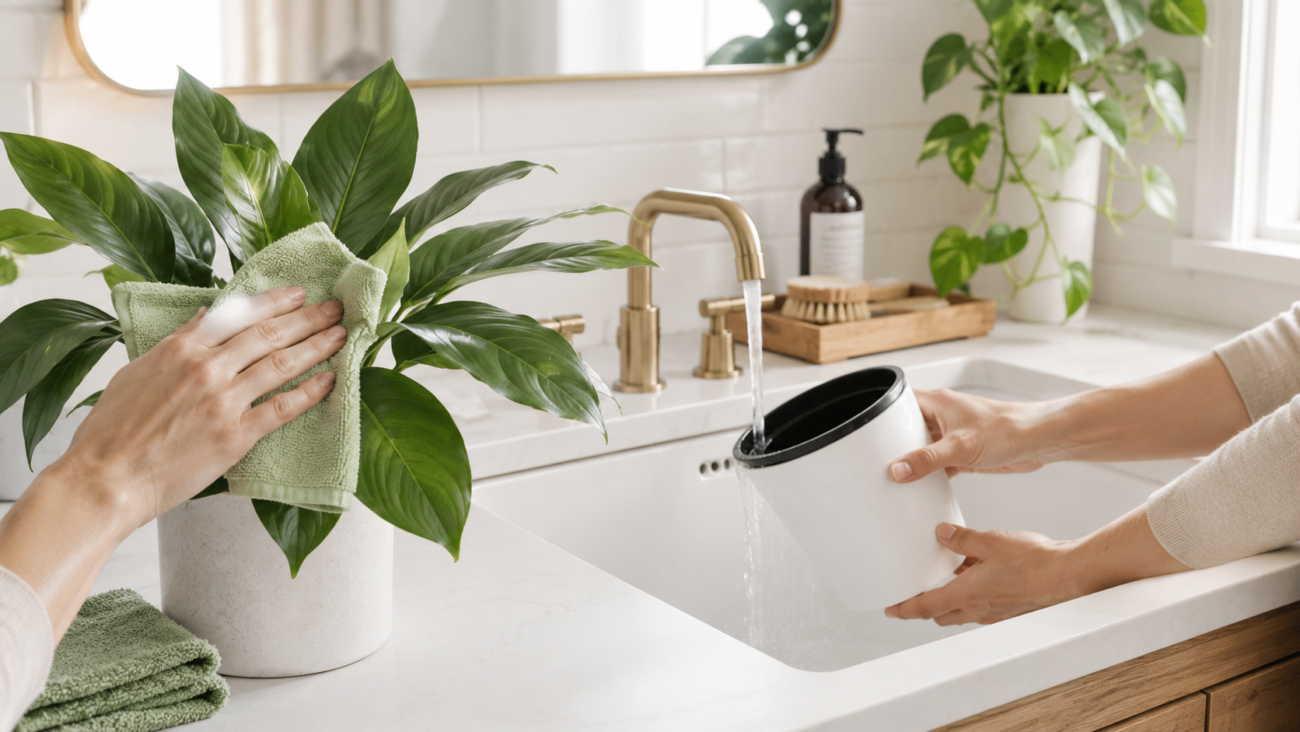
For routine care, wipe broad leaves with a clean microfiber cloth every one or two weeks. Support each leaf near the stem to avoid pulling it from the branch. A soft makeup brush can remove dust from tight rosettes and textured foliage.
For washable molded plants, remove the inner pot and rinse foliage with lukewarm water. Use a small amount of mild dish soap when residue is visible, then rinse and dry completely before returning the plant. Do not soak wired trunks, fabric flowers, glued gravel, battery compartments, or natural wood components.
Test any cleaner on a hidden leaf first. Strong solvents, abrasive pads, and concentrated bleach can change the surface finish or printed color. Never mix household cleaning products. Follow the plant manufacturer’s instructions when they differ from general care advice.
Cost, Quality, and Long-Term Value
Price varies with size, molding detail, stem construction, pot weight, and hand finishing. A small succulent may be an inexpensive accent, while a large, highly detailed tree can cost substantially more. Compare the plant itself rather than assuming an expensive decorative pot proves foliage quality.
Calculate value by expected years of use and the number of spaces in which the arrangement can work. Neutral greenery can move from a bathroom to an office, bedroom, or event display. Trend-specific flowers and brightly colored pots have less flexibility and may be replaced sooner.
Buying fewer, better artificial plants for bathrooms generally produces a calmer result and reduces cleaning time. Prioritize the item seen at eye level, where poor leaf printing and exposed joints are easiest to notice. Simpler budget pieces can work on a high shelf where viewers see the silhouette rather than every detail.
Common Styling Mistakes
The first mistake is using too many small plants. Six tiny pots scattered around a sink create visual clutter and complicate cleaning. Replace them with one medium arrangement or group three related pieces on a washable tray.
The second mistake is ignoring scale. A miniature succulent disappears beside a large tub, while an oversized palm overwhelms a compact powder room. Photograph the empty location and mark the proposed height and width with removable tape before buying.
The third mistake is leaving the plant in its compressed shipping form. Bend wired branches gradually, rotate leaves away from repeated patterns, and create an uneven outline. This five-minute adjustment often improves realism more than buying another decorative accessory.
Finally, do not use greenery to hide leaks, peeling paint, or recurring mold. Decor should be the finishing layer after the room is dry, ventilated, and easy to clean. Moisture problems require repair, not camouflage.
Artificial Plants Versus Live Bathroom Plants
Live plants remain appealing when a bathroom has suitable daylight, air movement, and an owner who enjoys plant care. They change over time and can offer the satisfaction of new growth. However, a humid room is not automatically bright enough for photosynthesis, and intermittent steam does not replace correct watering.
Choose artificial greenery for windowless rooms, rental turnovers, hard-to-reach shelves, and highly consistent styling. Choose live greenery when growing conditions match the species and regular care is realistic. A mixed approach can also work: keep a healthy live plant near the window and use a convincing artificial vine in the darker corner.
Bathroom Artificial Plant Buying Checklist
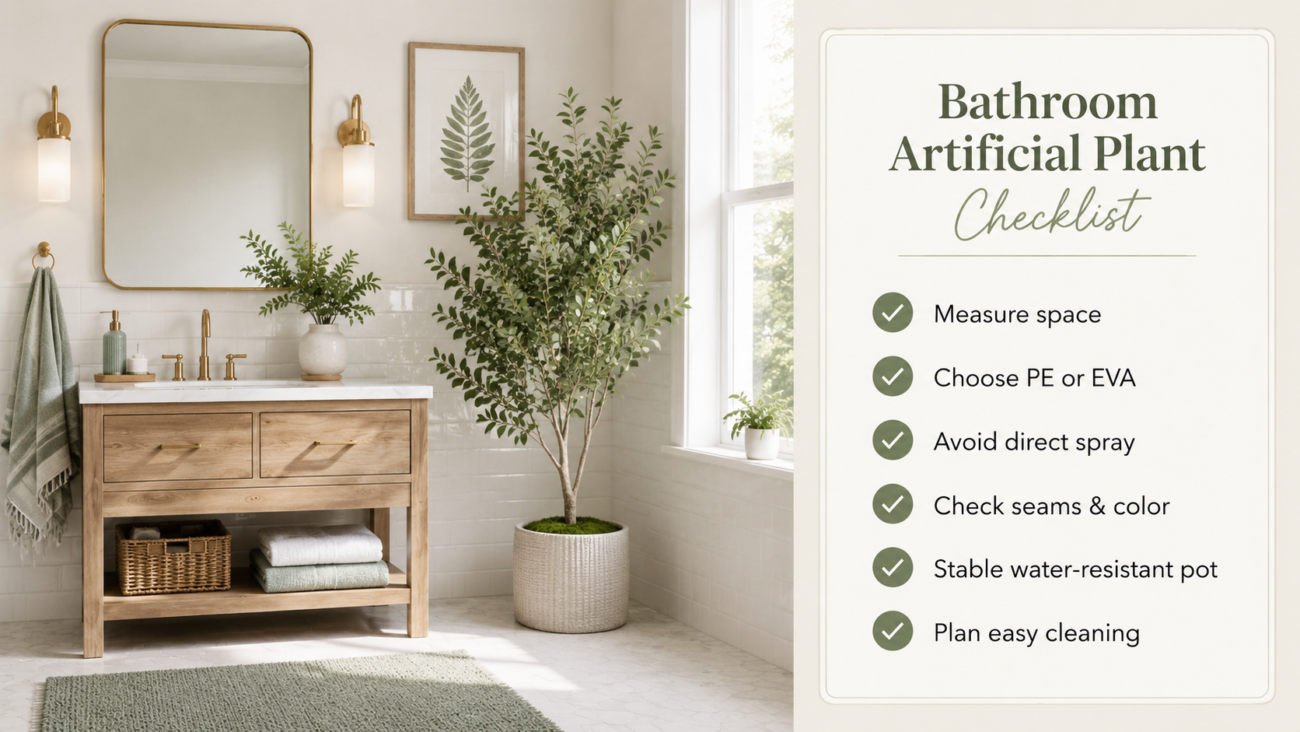
- Measure the available height, width, depth, and walking clearance.
- Choose washable PE or EVA foliage for areas exposed to humidity.
- Reserve fabric flowers and absorbent details for dry shelves.
- Inspect color variation, leaf undersides, seams, and branch joints.
- Confirm that the pot is stable and the decorative finish tolerates moisture.
- Keep plants clear of exhaust vents, direct spray, heat, and daily tasks.
- Plan a simple cleaning routine before choosing intricate foliage.
- Check the return policy in case scale or color differs from the product image.
Final Recommendations
The best artificial plants for bathrooms are not simply the most realistic models in a catalog. They combine convincing color and shape with washable materials, stable pots, appropriate scale, and sensible placement. Trailing pothos and ferns add softness, snake plants bring structure, succulents suit tight ledges, and restrained orchids create a polished guest-room focal point.
Begin with one location that feels empty, measure it, and choose a plant whose material matches the expected moisture exposure. Improve ventilation and fix leaks before decorating, then clean the foliage lightly and regularly. This approach delivers a better-looking bathroom without turning decor into another demanding chore.
Explore the CNGarden shop to compare suitable greenery and pots, review the complete fake plant buying guide, or see the guide to different types of fake plants. For wholesale quantities or a coordinated commercial project, visit the wholesale page or contact CNGarden for product guidance.
 English
  Arabic
  Dutch
Dutch  German
  French
  Portuguese
  Spanish
  Russian
  Japanese
  Korean