

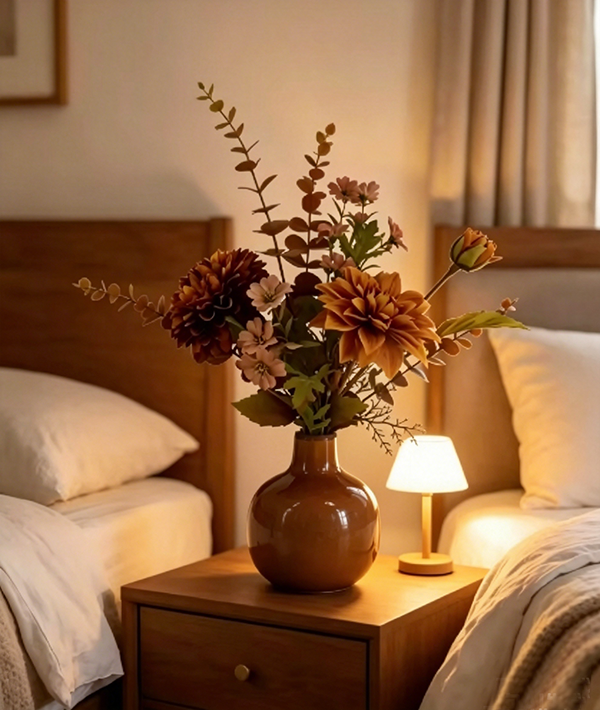
The gap between artificial flowers that fool people and ones that obviously don’t comes down to two things: the quality of the materials and how they’re arranged. Even the best fake flowers look unconvincing in a bad arrangement, and a thoughtful layout can make a mid-range product punch above its weight.
What Makes a Flower Look Real
Botanically accurate artificial flowers share a few consistent material traits. Petals made from layered polyester or silk blends, shaped by heat-pressing and finished with gradient dyeing, have the color variation that flat-dyed fabric lacks. A real rose petal isn’t one uniform hue — it deepens at the base and lightens toward the edge. Gradient dyeing replicates this, and it’s one of the clearest indicators of quality when comparing products.
Leaf surfaces matter equally. Realistic fake plants have veining pressed into PE-molded leaves, subtle surface texture, and a matte finish on the upper face rather than a plastic sheen. Touch also tells you a lot — quality materials have weight and slight flexibility; budget products feel hollow and snap rather than bend.
CNGARDEN uses multi-layer petal construction across its flower range, with colorfastness treatments that prevent the fading that typically gives artificial flowers away after a few months near a window.
Arrangement Principles
Vary stem heights. Real flower arrangements aren’t flat across the top. Work with different stem lengths so blooms sit at different levels, which also shows off individual flowers better.
Don’t pack too tightly or too loosely. Real flowers have natural spacing — adjacent blooms touch occasionally but aren’t crushed together, and there aren’t obvious gaps. Adjust wire stems to find the balance.
Add foliage. Isolated flower heads without leaves look staged. Mixing in fake plants — small leaf stems, eucalyptus, or filler greenery — gives arrangements the layered depth of something freshly cut.
Use the right vessel. Opaque ceramic or stone vases hide any mechanics. If using a glass vessel, either conceal the stems with decorative stones or choose stems that look convincing on their own.
Dried Palette Arrangements
Muted-tone artificial flowers — dusty pinks, warm taupes, aged creams — have become a dominant style in contemporary interiors. They work in farmhouse, Japandi, and modern aesthetics equally well, and unlike real dried botanicals, they won’t shed or crumble over time. For longevity and minimal effort, they’re one of the most practical decorative investments available.
 English
  Arabic
  Dutch
Dutch  German
  French
  Portuguese
  Spanish
  Russian
  Japanese
  Korean